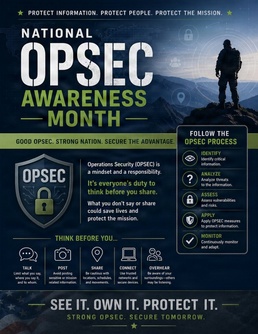
Editor’s Note: This editorial and professional commentary provided by Fort Leonard Wood Installation OPSEC Officer, Marti Yoshida. FORT LEONARD WOOD, Mo. — May is designated as National Operations Security Awareness month, making this a great time to revitalize our commitment to OPSEC and the programs that rely upon OPSEC to achieve force protection at Fort Leonard Wood. While commonly known as the “loose lips sink ships” program, OPSEC must work with all force protection disciplines, including Antiterrorism, where “See Something, Say Something,” is its oath. OPSEC seeks to maintain accountable transparency — a balanced approach, which considers both the importance of informing the public about installation activities and the fundamental requirement to protect critical information that could put missions at risk if improperly made public. The objective of the AT program is to help sustain mission assurance for the installation as part of its comprehensive protection plan. “Antiterrorism focuses on the defensive physical and procedural measures used to reduce vulnerabilities to terrorist acts,” said Lee Porterfield, Fort Leonard Wood AT officer. “The OPSEC process serves as a foundation to the installation's AT strategy by protecting mission-sensitive and personal details highly sought out by adversaries.” The integration of OPSEC and AT is especially important at Fort Leonard Wood due to its dynamic population and operational tempo, Porterfield explained. “The installation sees a constant throughput of initial entry training Soldiers, permanent party personnel, civilian employees, defense contractors and visitors annually,” said Porterfield, a 23-year veteran in the AT field. “It is important to protect even seemingly harmless details about access hours, maintenance schedules, duty rosters, assessments, and mission plans, because the disclosure of such details can significantly degrade the installation’s security posture and be exploited by adversaries,” he added. “If an adversary cannot gather enough intelligence to confidently predict force posture or vulnerability, the likelihood of an attack drops significantly.” To maintain a strong AT posture at the home of the U.S. Army Maneuver Support Center of Excellence and specialized training units, OPSEC principles must be applied by all personnel; and staying current with education and awareness is essential to the AT program. Ralph Hudson, a Combined Arms Center Protection specialist at MSCoE, echoed Porterfield’s observations. “In the context of antiterrorism, OPSEC is the invisible shield that disrupts an adversary's planning cycle long before physical security measures, such as barriers or armed guards, are ever tested,” Hudson said. Hudson, who provides oversight to MSCoE’s AT, physical security and OPSEC programs, said the link between protecting information and AT manifests in several practical ways. “For example, social media discipline prevents adversaries from obtaining locations, schedules, and daily routines of key personnel,” he said, “and shredding documents like rosters, and standard operating procedures and security measures, prevents adversaries from studying internal safety protocols.” According to AT and OPSEC officials, ongoing awareness and education keep all of us well-informed on how to recognize and report suspicious behavior, which in turn, allows ATOs to investigate and mitigate potential threats, ensuring that defensive measures are synchronized with the local threat environment and operational requirements. “ATOs, serve as the commander’s primary advisor for the AT program,” Porterfield said. “Their overarching mission is to protect personnel, to include servicemembers, civilians, contractors and families, information, property and facilities from terrorist acts.” The threat is real and can be overcome, but we must each do our part and empower constant vigilance, he said. “The two biggest measures that members of the Fort Leonard Wood community must do to help is to practice good OPSEC and report suspicious activity, because these two actions keep the installation safe and informed,” Hudson said. Hudson added another important AT measure is to share unclassified threat information with the local populace for maximum community involvement. “Knowledge isn’t power, shared knowledge is,” he said. “We need to ensure that our local citizens are aware of threats in the area.” OPSEC and AT are collective, installation-wide efforts that begin with ongoing, individual awareness and discipline as the foundation for mission integrity. “By understanding that every piece of unprotected information can be aggregated and weaponized by an adversary, the Fort Leonard Wood community actively reinforces its AT posture,” Porterfield said. “Constant OPSEC vigilance ensures that the installation can continue its critical mission of training the nation's Maneuver Support forces in a secure environment.” Porterfield summed it up by saying, “The success of the Fort Leonard Wood Protection Program depends on the collective vigilance of the entire team.” “Personnel must prioritize individual protection measures by safeguarding personal and family information on social media and maintaining a low-profile in public,” he added. To remain effective, every individual must act as a sensor; if you see or hear something suspicious, regardless of how minor it may seem, “say something” by reporting it immediately to the Military Police Station at 573.596.6141. By alerting the proper authorities individuals can contribute to the safety of the installation and may ultimately save lives. For additional information, contact the installation OPSEC office at 573.563.2402 or AT offices at 573.563.5507/2068.