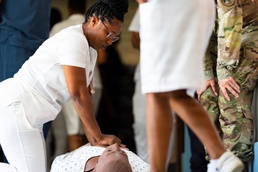
CASTRIES, Saint Lucia — When a patient collapses in a hospital, seconds matter. The ability to respond as a coordinated team can save lives.
During the Lesser Antilles Medical Assistance Team (LAMAT) 2026 mission, U.S. Air Force medical personnel and Saint Lucian healthcare educators worked side by side to build a more unified, hospital-wide emergency response approach, designed for speed, coordination and long-term sustainability.
“They didn’t have a formal code response system in place, so we worked with their educators to explore what that could look like,” said U.S. Air Force Maj. Samantha DiBlasi, LAMAT 2026 co-mission director and clinical inspector with the Air Force Inspection Agency. “The goal is for them to build something they can sustain.”
The engagement focused on developing a repeatable code response system for hospital-wide medical emergencies through a train-the-trainer approach that hospital staff can continue refining after the mission.
Participants then tested that process in real-time during a simulated emergency scenario, coordinating patient care, communication and equipment movement under pressure.
“We placed a simulated patient in a random location and asked them to respond,” DiBlasi said. “That’s when you start to see the gaps, but also where real learning happens.”
For hospital leadership, the exercise marked a shift from individual clinical instruction to integrated, system-level response.
“We’ve done individual skills training before, but today brought all the components together,” said Ruth Regis-Adesanya, senior manager for quality at Owen King European Union Hospital. “When you put everything into a scenario, that’s when you really start to see the gaps.”
The exercise also supported ongoing efforts to formalize a code blue response system within the hospital.
“This will definitely strengthen our code blue system,” Regis-Adesanya said. “We already had a plan in place, and this helped us identify areas we need to improve and move forward.”
By identifying delays in communication, equipment access and coordination, the scenario provided actionable insights that hospital leadership can use to guide future policy development and staff training.
“The results of this training and the gaps identified will be reported at the senior management level to guide our strategies for improvement,” Regis-Adesanya said.
For participants, the experience reinforced both technical skills and confidence in responding to emergencies.
“I just graduated in December and have only been working for about a month,” said Peter Phillip, a staff nurse at the hospital. “After the training, I feel more prepared to respond in an emergency situation.”
Phillip emphasized the importance of communication and leadership in high-pressure medical scenarios.
“You need to be confident, direct, and make sure your team understands what you’re asking so the process is done properly,” he said.
The train-the-trainer model ensures the knowledge gained will continue to spread throughout the hospital. “I’m going back to my unit to demonstrate what I learned to my coworkers,” Phillip said.
Medical leaders said rapid response capability directly impacts patient outcomes.
“Every delay in response can lead to a worse outcome,” DiBlasi said. “Building a system that gets care to the patient quickly is critical.”
Through collaboration and shared expertise, both U.S. Air Force and Saint Lucian teams reinforced their ability to respond to emergencies while strengthening partnerships that will endure beyond the mission.
“By building these relationships and exchanging ideas, we’re better prepared to work together if a real-world incident happens,” DiBlasi said.
LAMAT 2026 is part of a broader health security cooperation effort that enhances medical readiness while supporting partner-nation healthcare systems across the Caribbean.
“Education is a key part of readiness,” DiBlasi said. “If you invest in educators, you build people who are ready to respond—and that’s what ultimately improves patient care.”