FORT LEONARD WOOD, Mo. — Soldiers from the inaugural class of the U.S. Army Military Police School's new Advanced Small Unmanned Aircraft System Operator Course are already applying their skills in the field, as USAMPS prepares for its second cohort in June 2026.
“For a military police officer, a UAS is more than just a camera in the sky,” said Sgt. 1st Class Jonathan Self, who is assigned to the USAMPS Directorate of Plans and Operations and helped develop the two-week course. “It is a critical tool that provides a significant advantage in standoff capability, information gathering and Soldier safety across all disciplines.”
According to USAMPS Chief of Staff Lt. Col. Alex Foster, this course is pioneering curriculum for the U.S. Army Maneuver Support Center of Excellence.
“The USAMPS Advanced UAS Operators Course is the first branch specific functional course aimed at providing UAS operators the requisite skill sets to leverage UAS platforms across the full spectrum of MP operations in support of large-scale combat operations, law enforcement on installations and force protection,” Foster said. “We are building the technical skills required to operate in confined quarters, mask detection and provide practical applications for MP Soldiers to support their commanders as they direct operations to protect the force both (at home and abroad).”
Course development prioritized transitioning beyond basic piloting to focus on the tactical complexities of advanced mission integration.
“It teaches them how to employ the UAS as a weapon system and intelligence-gathering asset to solve complex tactical problems. This advanced skill set simply did not exist for these Soldiers prior to attending this course,” Self said. “This program isn't just about flying drones; it's about fundamentally enhancing how our military police conduct their missions on the battlefields of today and tomorrow.”
The course is designed to forge expert-level operators on next-generation drone technology, Self added.
“The purpose of this course is to bridge the critical gap between a standard, newly qualified UAS operator and a certified master trainer,” Self said. “While basic qualification teaches a Soldier how to fly, this advanced course provides them with the tactical and technical proficiency to complete complex tasks in high-stakes environments.”
Soldiers who take the course are certified on two distinct platforms — an AI-driven drone capable of navigating complex indoor environments and an infrared thermal platform designed for field surveillance.
Self said graduates possess the specialized skills to leverage UAS for a wide range of operational requirements, from reconnaissance and search operations to detainee and security missions.
“In short, this training gives our Soldiers the ability to see without being seen, to know what's over the next hill or inside the next building, and to make better, faster and safer decisions in any environment,” he added.
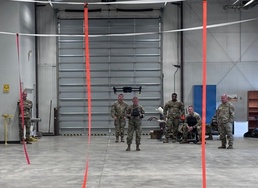
According to Foster, a facility within one of Fort Leonard Wood’s range complexes was recently repurposed to support the specialized MP UAS curriculum, specifically to accommodate the course's emphasis on advanced indoor flight operations.
The indoor training includes traversing through complex obstacles designed to simulate real-world environments.
“This challenging phase pushed operators to conduct precise target and evidence acquisition, which served to fine-tune their camera manipulation skills under pressure,” Self said.
Also included in the curriculum is a specialized module on interior flight operations, where Soldiers master precision maneuvering through multi-room structures and complex obstacles in confined spaces.
“They are applying advanced skills to fly inside and through tight spaces, such as shipping containers, to simulate clearing buildings and other structures,” Self said. “We push operators beyond simple flight maneuvers.”
The challenge deepened after nightfall, as students were required to maintain operational proficiency in zero-illumination, low-visibility conditions.
“During night operations training, they learned to use thermal cameras to identify targets and navigate in complete darkness,” Self said. “This included both exterior and indoor night flight.”
While the curriculum uses two specific small UAS platforms, Self emphasized the training is platform-agnostic, ensuring that the skills are transferable to any system in the Department of War inventory.
“Our course builds on that by developing the core competencies and critical thinking skills that make an operator effective, regardless of the system they are using. We recognize that units across the force may have access to different small UAS models, so our curriculum is designed to produce adaptable, problem-solving operators, not just pilots trained on one piece of equipment,” he said.
Sgt. 1st Class Ross Boehm, an operations NCO with the 118th Military Police Battalion, 43rd Military Police Brigade, Rhode Island Army National Guard, was among the first group of Soldiers to complete the new USAMPS advanced small UAS curriculum.
Crediting the course with making him a more versatile asset, he said the potential applications for the skills he gained are “limited only to the imagination of the user."
“This course taught us all the skills required to be an effective, lethal and professional small UAS operator,” Boehm said.
He plans to leverage his graduation from the course to train other Soldiers in his unit, bringing these new drone capabilities to Rhode Island.
“I look forward to returning to my home station and working with senior staff members to implement a small UAS program and create meaningful training for our Soldiers,” Boehm said. “This training creates expert small UAS operators that will take this knowledge base and spread it throughout the formations and ranks of the MP Corps, enhancing the next generation of MP warfighters.”
Boehm called it an “honor” to be selected for the inaugural class and to play a role in shaping the development of such “critical training.”
According to Self, there are still a few seats open for the next course set to begin June 15, 2026. The deadline to submit names for review and prioritization is May 18, 2026.
“Currently, the course is open exclusively to the MP community. Although there are no mandatory prerequisites, we encourage units to identify and send individuals who have a vested interest or prior experience in UAS,” Self said.
To apply for a seat, units are directed to contact Sgt. 1st Class Jonathan Self at [jonathan.d.self.mil@army.mil](mailto:jonathan.d.self.mil@army.mil).