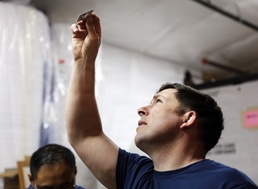
Soldiers with the 141st Military History Detachment spent their annual training preserving the legacy of the force by supporting the Washington National Guard Museum and History Center through cleaning, organizing, cataloging, and assessing historical artifacts at Camp Murray, May 4-8, 2026.
The mission gave the soldiers an opportunity to directly support the preservation of Washington National Guard history while assisting the museum staff with projects requiring additional manpower and historical expertise.
“The Washington National Guard Museum & History Center’s mission is to collect, preserve, interpret, and exhibit the history of the Washington National Guard to educate the force, foster esprit de corps, honor past service, and communicate the Guard’s story to the broader community,” said Dr. Stephanie Carter, curator of the Washington National Guard Museum and History Center. “The recent assistance the 141st MHD gave the Museum & History Center was vital in allowing us to continue to fulfill that mission.”
As a two-person department responsible for preserving and maintaining decades of Washington National Guard history, the museum staff often balances multiple projects and priorities at once.
“We get pulled in many directions and for various tasks,” Carter said. “Sometimes that means we don’t get to put as much attention on particular focus areas as we’d like. Having the MHD spend their annual training here allowed us to tackle several very large and important projects.”
Throughout the training, soldiers reorganized storage areas, assembled shelving and cabinets, inventoried weapons and historical artifacts, and assisted with identifying dozens of boxes containing unknown historical items.
“The adage that ‘many hands make light work’ has proven to be true, and we’re very grateful for the assistance,” Carter said.
On the first day of the mission, museum staff introduced the soldiers to the history of the building, museum operations, and artifact preservation techniques.
“We gave them a history lesson on the building, the museum itself, and a ‘Collections 101’ crash course on how we care for, handle, and process artifacts,” Carter said.
That training led directly into one of the mission’s most significant projects: sorting and identifying previously unprocessed historical materials.
“This led to their assistance with a very important task: helping us triage dozens of boxes of unknown artifacts,” Carter said. “A real history mystery.”
The soldiers examined the contents of the boxes, identified potential artifacts, and created preliminary inventories to help museum staff better understand the scope of items awaiting formal accession into the collection.
“These lists now give us a better idea of what artifacts we have that have yet to be formally added to the collection,” Carter said.
The 141st Military History Detachment also assisted with setting up a new curator workroom, building shelving units, rearranging storage areas, and creating additional workspace needed to process and preserve artifacts.
“Getting this room in working order was important to allow us to have the dedicated space to now process artifacts,” Carter said.
For the soldiers of the 141st MHD, the mission provided an opportunity to work directly with Washington National Guard history while strengthening their understanding of the role military historians play in preserving institutional memory.
“Supporting the museum is especially important for the 141st MHD,” said Capt. Chad Lucero, commander of the 141st Military History Detachment. “It is a special state mission that is entrusted only to us. We are given an opportunity to encounter our state's military heritage hands-on and doing so helps us to think like historians and to reflect on the lives of the soldiers and airmen who preceded us in the Washington National Guard.”
During the week-long mission, soldiers uncovered journals, photographs, uniforms, coins, and personal items belonging to Guardsmen who served in previous conflicts.
“We found several old journals and mementos from National Guard soldiers who served in past conflicts,” Lucero said. “The most unique find was an old first aid kit, which had many of its components still intact and wrapped.”
Lucero said handling the historical items gave soldiers a deeper appreciation for those who served before them.
“It was a privilege to handle these relics and see these items with our own eyes and picture how past service members may have trained and served using these items,” Lucero said.
The support provided by the 141st MHD not only helped improve organization and accessibility within the museum collection, but also strengthened the partnership between the museum staff and the military historians tasked with preserving the Washington National Guard’s story.
“The work the MHD did to help us complete these projects has really been a huge help in allowing us to better care for our collections and continue to fulfill our mission,” Carter said.
Carter added that other Washington National Guard members interested in supporting the museum can coordinate volunteer projects directly with the museum staff.
“If other Guardsmen are interested in assisting us here at the Museum & History Center, they just need to contact us,” Carter said. “We can plan out a project and provide specialized training in that area.”