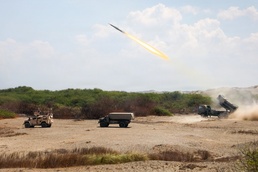
PAOAY SAND DUNES, Philippines – In a powerful demonstration of allied interoperability, 3rd Marine Littoral Regiment served as the mission commander for a complex, live-fire maritime strike, as a culminating event during Exercise Balikatan 2026, integrating Philippine, U.S., and Japanese strike capabilities. The operation showcased the Hawaii-based regiment's ability to seamlessly connect a vast network of combined and joint partners, orchestrating precise, layered maritime firepower.
At the heart of the operation, 3rd MLR acted as the mission commander under the exercise’s Combined Joint Task Force. Specifically designed to persist in contested littoral environments and enable multi-domain, integrated effects to expand decision-making for combined and joint commanders, 3rd MLR exercised its ability to command and control the complex, two-day live-fire event leveraging its Fires and Air Direction Element. The regiment coordinated across vast distances, weaving together a web of allied sensors and strike capabilities to engage maritime targets with overwhelming multinational force.
The event represented the strength of the Philippine-U.S. alliance coinciding with the 75th anniversary of the U.S.-Philippine Mutual Defense Treaty, illustrating the deep network of nations committed to regional security and prosperity. During two separate live-fire days, an array of multinational intelligence, surveillance, and reconnaissance platforms alongside fixed wing aircraft, ground-based systems, and ship-based capabilities, operated in tandem to execute a combined, distributed maritime operation.
“The MARSTRIKE was a seamless demonstration of the relationships we have with our allies and partners,” said Maj Quinton Boyd, the deputy fires and effects coordinator with 3rd MLR. “From the relentless preparation and planning with them, to the live-fire execution, it’s clear that we can operate as a truly interoperable force.”
On the first day of the event, the combined force struck the Philippine Navy BRP Quezon (PS-70), a decommissioned vessel that served as the pre-arranged target with ground-based capabilities. As the mission commander, 3rd MLR coordinated with the Japan Ground Self-Defense Force, firing Type-88 Surface-to-Ship Missiles, and with the U.S. Army 7th Infantry Division employing the High Mobility Artillery Rocket System to engage the decommissioned vessel. In addition to the Type-88 and HIMARS live-fire, a Navy-Marine Expeditionary Ship Interdiction System assigned to 3rd Littoral Combat Team, 3rd MLR, simulated a firing mission as part of the exercise.
On the second day, Philippine Air Force FA-50PH Fighting Eagle and A-29 Super Tucano aircraft engaged another pre-arranged target, the BRP Magat Salamat (PS-20). The aircraft utilized targeting data synthesized by 3rd MLR to systematically strike and ultimately sink the decommissioned Philippine Navy vessel.
Multinational sensors, command and control, and simulated strike capabilities from the U.S. Navy, U.S. Air Force, Philippine Navy, JGSDF, and Royal Canadian Navy were also critical contributors to the two-day MARSTRIKE event and were interlinked with 3rd MLR’s Fires and Air Direction Element through the operation.
“The successful execution of MARSTRIKE underscored the interoperability of the combined, joint force - integrating capabilities from the Philippines, Japan, Canada, and U.S. Joint Forces across the Army, Navy, Air Force, and Marine Corps,” said Col. Gabriel Diana, the commanding officer of 3rd MLR. “The operation demonstrated our ability to synchronize intelligence collection and fires, ultimately layering and converging lethal effects against maritime targets.”
The execution of the complex, multilateral operation during Exercise Balikatan 2026 highlights the capabilities of a deeply integrated, lethal allied force operating across air, land, and sea, advancing the spirit of a longstanding exercise into the modern, multi-domain battlespace.
Balikatan is a longstanding annual exercise between the Armed Forces of the Philippines and U.S. military that represents the strength of our alliance, improves our capable combined force, and demonstrates our commitment to regional peace and prosperity.