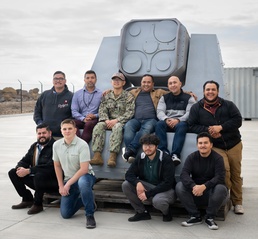
Sailors can now get certified in operating and maintaining the fleet’s most prevalent directed energy system through a new training program at Naval Surface Warfare Center, Port Hueneme Division (NSWC PHD)’s Directed Energy Systems Integration Laboratory (DESIL), with the first course completed in late March.
The Navy recently designated DESIL as the official schoolhouse for the Optical Dazzling Interdictor, Navy (ODIN), seven of which sit on Navy ships. The courses will build the fleet’s knowledge base on that system specifically and directed energy more broadly, while also enabling sailors to earn a new Laser Weapon System Operator Navy Enlisted Classification (NEC) that NSWC PHD spearheaded.
While weapon system instruction for fleet personnel normally falls under Surface Combat Systems Training Command (SCSTC), DESIL’s in-house directed energy subject matter experts (SMEs), equipment and infrastructure make it uniquely equipped to serve as the ODIN schoolhouse, according to Davidson Sim, directed energy sustainment systems engineer.
“Our facility has the SMEs — and subsequently the trainers — and a resident ODIN system,” Sim said. “And we have access to a test range, allowing us to actually emit and use the laser in a training environment.”
DESIL, perched on the oceanfront at Naval Base Ventura County Point Mugu in California, is the Navy’s only facility for testing directed energy in a maritime environment — offering line-of-sight to the Point Mugu Sea Range and access to sea, air and land targets.
Although ODIN is not a Navy program of record at this time, NSWC PHD pitched SCSTC on the need for an official training program because of how the fleet has been using the directed energy system and how it has matured since it went into service in 2020.
ODIN’s dazzling laser is designed to blind the sensors of unmanned aerial systems. The system also offers powerful intelligence, surveillance and reconnaissance features, such as cameras and a telescope, allowing operators to see farther and capture footage of adversaries in high detail and resolution.
That technology is only effective in the hands of sailors trained to operate and maintain it, which is where the schoolhouse comes in, according to Lawrence Averion, directed energy branch manager.
“It’s about making sure the warfighters are ready to use the systems, and giving them the confidence that they can actually meet the mission,” Averion said.
The schoolhouse will also provide a new professional development opportunity for sailors working with directed energy systems.
Directed energy education
An NEC is a specialization within a sailor’s rating. The DESIL team worked with the Navy Manpower Analysis Center, known as NAVMAC, to establish the new Laser Weapon System Operator NEC, which also required endorsements from the Office of the Chief of Naval Operations and Program Executive Office Integrated Warfare Systems. It became official Feb. 4.
The NEC is akin to a major in an academic degree, according to Illiana Rausch, an administrative technical specialist in NSWC PHD’s directed energy branch who worked on developing the new Laser Weapon System Operator NEC.
“It’s like your specific field of study in college — you’re specialized in this area,” Rausch said.
Sailors who take the ODIN courses and earn the laser NEC will be in the fire controlman rating. Sim said the Navy has been leveraging fire controlmen with NECs for conventional armaments — for example, the close-in weapon system — to operate and maintain ODIN.
“This sparked the need for a new NEC, because directed energy weapon systems are unique from guns and traditional ordnance,” Sim said.
To earn the new Laser Weapon System Operator NEC, NAVMAC requires sailors to complete two ODIN courses at DESIL.
Comprehensive curriculum
The two courses, each lasting five days, will combine classroom instruction with hands-on learning with the ODIN unit at DESIL.
One course focuses on operating ODIN — using a console to master key functions like tracking and locking on targets, firing the dazzling laser and managing critical alerts.
Tracking targets is one of the more challenging aspects of learning to use a directed energy system like ODIN, according to Averion. When an object is far away, it appears as a mere pixel on the operator’s screen and can be hard to follow. The opportunity to practice locking on real-life targets with the ODIN unit and console at DESIL will help “immensely” with that learning curve, Averion said.
The other schoolhouse course covers maintaining ODIN — how to conduct effective preventive and corrective maintenance for ODIN and its subsystems. Sailors will learn to utilize the ODIN manual and Maintenance Requirement Cards, and they’ll practice those required upkeep procedures on the ODIN equipment at DESIL.
Sim will initially teach the courses while training others at NSWC PHD to take on the role. Specifically, the goal is to have command military personnel undergo training on classroom instruction techniques and tap their experience with ODIN so they can instruct sailors from the fleet on the system.
“So it becomes military training military, which we think is most ideal,” Sim said.
Leveraging the military personnel as trainers will also be more cost-effective than paying civilian employees to do it, Sim explained, which will be especially critical over the next two years before an external funding source kicks in.
Ships and shore-based commands can find the ODIN schoolhouse offerings in the Catalog of Navy Training Courses.
The directed energy team has started promoting the ODIN courses to ships equipped with that system. They also plan to bring in sailors from USS Preble (DDG 88), which is outfitted with a different directed energy weapon — the High Energy Laser with Integrated Optical-dazzler and Surveillance system, known as HELIOS.
“Our training is tailorable,” Sim said. “It’s ODIN training, but really it’s directed energy training.”
ODIN, HELIOS and the Solid State Laser Technology Maturation system — which is also at DESIL — all employ the same user interface, known as the Laser Weapon System Console. That and other similarities among the systems, such as their general maintenance philosophy, allow the schoolhouse to broaden the scope of the instruction beyond ODIN, Averion said.
Accordingly, the USS Preble personnel will learn fundamentals of directed energy systems while at DESIL, and then an SME will cover details specific to HELIOS when they return to their ship, Sim explained.
Commands that support the fleet can also make use of the training. The first course brought in personnel from the Navy’s Board of Inspection and Survey, known as INSURV, to increase their knowledge of ODIN for when they inspect ships with the system.
Regional maintenance centers (RMCs) are also among the target audience for the courses. Sim said this will help expand the support network for ODIN by training RMC personnel to respond first to ships’ casualty reports with the system. That, in turn, could reduce the need for NSWC PHD ISEAs to travel for onboard technical assistance, according to Sim.
ODIN and beyond
There are eight ODIN units in all. The system at DESIL came from USS Kidd (DDG 100) when it was entering a two-year maintenance availability in Everett, Washington.
Along with the training program, the directed energy team uses its resident ODIN unit for testing, and it maintains and sustains the system, which the type commander pays for and appreciates, Sim said.
“DESIL has become a trusted agent to the fleet,” he said.
The current ODIN unit at DESIL is slated to go back aboard USS Kidd in about a year, at the end of the ship’s maintenance availability. After that, the team expects to get systems from other destroyers as they enter the shipyard for extended periods.
“Basically for the next decade or so, we should have an ODIN unit from a ship that’s going into an upgrade,” Sim said.
Meanwhile, as the Department of War develops new generations of directed energy weapons, the ODIN course will serve as a stepping stone for supporting future systems, according to Sim.
Establishing the schoolhouse also reflects how far the field of directed energy has progressed.
“When NSWC PHD got started in directed energy, it was basically science projects,” Sim said. “Now these ODIN systems have proven themselves important in a tactical environment. … We’ve overcome the hurdles of embracing directed energy, and we can take that foundation and apply it to the next-gen systems.”
The years of experience that the NSWC PHD team has accumulated fielding the existing systems in the fleet, along with the recent efforts to establish the schoolhouse, have positioned DESIL to become the “center of excellence” for future directed energy training across the Department of War, according to Averion.
“We’re essentially postured and ready to take those new systems and train all the military to use them,” he said.