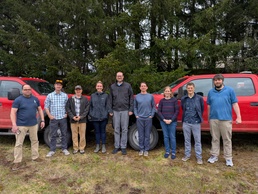
JOINT BASE LEWIS-McCHORD, Wash. –Joint Base Lewis-McChord’s Species Management and Modeling Team, and its leader, Chris Beck, JBLM Environmental Division chief, received the 2026 Secretary of the Army Environmental Award for Natural Resources Conservation in the Individual/Team Category in April, highlighting their work to meet both on-base species conservation and training goals, promoting warfighter readiness.
“The JBLM team is really on the cutting edge of how we're doing species management here with the Army,” said team member Derek Dapp, JBLM science advisor.
Several species on the more than 90,000-acre base are listed under the Endangered Species Act, which comes with specific conservation guidelines, according to the team’s award submission summary.
The group’s work is part of a joint initiative with the Department of the Interior and Department of War, which aims to “increase training flexibility in the face of some of the species' conservation needs” on military bases, Dapp said.
To meet this goal, the JBLM team developed a habitat-based population modeling management framework that includes endangered species benchmarks. When the benchmarks are met, training flexibility increases.
Additionally, the team built a mathematical model that helps predict the species impacts of certain activities, like artillery training and construction. This is helpful, as determining low-species-impact activities can help the base receive regulators’ approval, and determining high-species-impact activities can assist base leadership with making decisions and building in mitigations, Dapp said.
“By pioneering a highly innovative, predictive species modeling framework, Joint Base Lewis-McChord successfully restored restricted aviation operations and identified over $10 million in cost savings while charting a course to eliminate Yelm pocket gopher training restrictions,” according to a congratulatory email sent to JBLM Garrison Commander Col. Joseph Handke from the Office of the Assistant Secretary of the Army for
Installations, Energy and Environment. “This proactive, scientifically driven approach to ecosystem management not only expands critical maneuver space but also establishes a scalable Department of War standard.”
Beck initially wrote a paper on modernizing natural resources and conservation across the Department of War, which was approved by the late Ryan Orndorff, director of Conservation and Environmental Portfolio, Office of the Secretary of War.
“He gave me the green light to pilot this” after reading my paper, Beck said. “Without his approval and announcement, we would not have been able to move forward.”
Beck’s vision became a reality with the teamwork that led to the award, which Beck described as, “the pinnacle of our success together.”
And because of their success, “we have been asked by the Air Force, Army National Guard and other Army installations to assist with some of their pressing mission-critical issues,” Beck said.
“It's been exciting to take my skills and apply them to help build this modeling framework, that I think really has the potential to make a difference and to help us to do things better — both to maximize our training flexibility and to benefit species, too,” Dapp said.
To learn more about JBLM’s Environmental Division, visit [https://home.army.mil/lewis-mcchord/my-Joint-Base-Lewis-Mcchord/all-services/public_works-environmental_division](https://home.army.mil/lewis-mcchord/my-Joint-Base-Lewis-Mcchord/all-services/public_works-environmental_division).