By Bernard S. Little Walter Reed National Military Medical Center, Hospital Communications
“Penetrating traumatic brain injury (pTBI) is an inherent risk that every service member accepts,” said U.S. Army Capt. (Dr.) Jackson Rudolph, of the Department of Neurosurgery at Walter Reed National Military Medical Center.
To better treat those with pTBIs, Rudolph and his research team did a case study concluding, “Use of diagnostic cerebral angiogram (DSA) should be strongly considered despite [a] negative Computed Tomography Angiography (or CT Angiography) screening for traumatic pseudoaneurysm especially when pTBI involves the anterior skull base.”
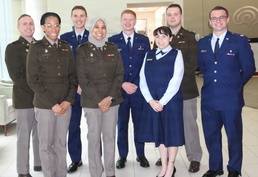
Rudolph’s project was one of a number of case studies presented by interns, residents, fellows and staff members at Walter Reed on April 28 as part of the Department of Research Programs’ (DRP) 18th Annual Research and Innovation Month.
Research and Innovation Month, held annually starting in late April and extending through May, highlights the crucial, cutting-edge studies and medical research projects produced by individuals and teams at Walter Reed focused on enhancing patient care and military readiness. In addition to case study posters and presentations, events also include the Paul Florentino Patient- and Family-Center Care/Quality and Performance Improvement presentations, and the Research Symposium for Laboratory and Clinical work with the Robert A. Phillips and Bailey K. Ashford awards. This year’s symposium also included the inaugural nurse-led research presentations named for Janet Rexrode Southby, who served as chief nurse at the former Walter Reed Army Medical Center. Navy researchers also compete in the Navy-Wide Academic Research Competition, this year hosted by Naval Medical Center Portsmouth (NMCP), located in Portsmouth, Virginia on May 15.
These case studies help move military medicine forward, according to Walter Reed’s DRP staff. The studies help “point the way toward new paths in medicine,” explained Rachel Jenkins, Ph.D., DRP’s education program specialist and team lead for Research Education Services and the Research and Innovation Month Committee.
“The case reports are about bringing researchers together from different training programs to share and generate new ideas leading to future collaborations,” she added.
Retired U.S. Army Col. (Dr.) Clifton Yu, deputy director of Education, Training and Research at Walter Reed, agreed. He said the studies, focused on complex cases exploring ways to enhance warrior, pediatrics and family care, bring patients to Walter Reed for its presidential care. “This is where state-of-the-art care is delivered, and there’s no place that they’re going to get better care,” he added.
Yu shared that research is in Walter Reed’s DNA, explaining that Research and Innovation Month serves as a reminder that the medical center is also an academic institute, providing graduate medical education and training for military physicians, nurses and other healthcare professionals.
“To promote and maintain readiness, we have to treat patients, teach and train our military healthcare personnel, and perform research to meet the health challenges of service members and their families. Meeting these challenges often has benefits and applications for civilian healthcare as well. Our namesake, Maj. Walter Reed, was a soldier, clinician, teacher, and researcher.”
In addition to Rudolph’s work examining pTBI, other studies included: U.S. Army Capt. (Dr.) Callum Dewar’s research into front-ethmoidal encephalocele repair in prematurity; U.S. Army Capt. (Dr.) Benjamin Swanson’s work focused on unilateral cochlear nerve deficiency; U.S. Army Capt. (Dr.) Kalei Hering’s research on limb-shaking transient ischemic attacks; and U.S. Air Force Capt. (Dr.) Daniel Rabe’s’case study involving Extensive Burkitt lymphoma evading tumor lysis syndrome.
U.S. Navy Lt. (Dr.) Ervin Anies researched ultrasound guided chemodenervation for post-operative ankle pain and also post-traumatic musculocutaneous axonal neuropathy resolved with peripheral nerve stimulator, which U.S. Army Lt. Col. (Dr.) Nicole Vietor, chief of endocrinology at Walter Reed, noted could have great application for care of deployed service members.
U.S. Air Force Capt. (Dr.) Keenan Caswell discussed “leveraging military medical infrastructure for global continuity of care in a pediatric patient,” highlighting the successful effort in transporting a young patient and family members from overseas via military flight to Walter Reed for its specialty care for a ruptured arteriovenous malformation.
U.S. Air Force Capt. (Dr.) Kathleen Crandall’s studied pediatric achalasia in autism spectrum disorder, and U.S. Army Capt. (Dr.) Simal Ali presented her case study of a successful fire ant immunotherapy of a service member stung during military field training.
Other case studies by interns and residents included those involving orbital apex syndrome and cavernous sinus thrombosis (U.S. Army Capt. (Dr.) Michael Pierce); two-lung ventilation following Iatrogenic lung injury (U.S. Army Capt. (Dr.) Joseph Settineri; Anakinra in refractory Kawasaki disease with coronary artery involvement (U.S. Navy Lt. (Dr.) Elizabeth Dullea); stopping cholestasis before it starts (U.S. Air Force Capt. (Dr.) Leanne Perez); segmental arterial mediolysis involving the gastroduodenal artery (U.S. Air Force Capt. (Dr.) Mason Life); and cutaneous and erosive oral lichen planus treated with upadacitinib (U.S. Army Capt. (Dr.) Obarikanemi Nwogu).
Case studies by Walter Reed fellows and staff included those involving primary hyperparathyroidism presenting in pregnancy (U.S. Navy Lt. Cmdr. (Dr.) Gregory Schmit; *novel use of endorectal balloon safety facilitated curative salvage radiation therapy for a patient with macroscopic local recurrence in prostate bed after radical prostatectomy (*U.S. Navy Lt. Cmdr. (Dr.) Whoon Jong Kil; methimazole therapy in duff-null associate neutropenia (U.S. Navy Lt. Cmdr. (Dr.) Kathryn Flynn); and “a breathtaking bleed,” focused on diffuse large B cell lymphoma, the most common hematologic malignancy diagnosed in active-duty service members, with 30 to 50 diagnosed cases each year (U.S. Army Capt. (Dr.) Alexander Di Scenna).
Yu added that some case studies expand to larger projects involving a greater pool of participants to further enhance care provided beneficiaries of the Military Health System.