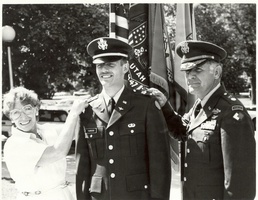
After a distinguished 38-year career in the U.S. Army, retired Lt. Gen. Neil Thurgood made the transition from active duty to the private sector. His military journey began as an infantry private, then progressed through his Army career as an aviator, who served in both conventional forces and special operations, then ultimately joined the Army Acquisition Workforce.
Prior to retiring from the Army in November 2022, Thurgood served as the director for the Army’s Rapid Capabilities and Critical Technologies Office (RCCTO)—an organization whose mission is to accelerate critical capabilities and technologies to Soldiers in the field and to meet Army modernization priorities, address urgent and emerging threats and support acquisition reform efforts. He played a key leadership role in standing up the RCCTO—designing the organization, shaping its mission and determining required legal authorities. Recently, RCCTO merged with other program executive offices into Portfolio Acquisition Executive (PAE) Fires.
“What we really created was an organization that was small teams, and I’m a big fan of small effective teams that can move at pace within the law and bring together all of the things that you now see in the PAE structure. So, the RCCTO was the first instantiation of what we now call the PAE structures,” said Thurgood.
After retiring, Thurgood wanted to continue sharing his acquisition expertise supporting the defense industry. In January 2023, he accepted a senior executive leader position at https://www.anduril.com—a defense technology company that specializes in advanced autonomous systems. Although he was initially unfamiliar with Anduril, he stated that one of the factors that inspired him to join Anduril’s team was their culture. “The culture of Anduril is very much like the culture of the last organization I had, which was the Army’s Rapid Capabilities and Critical Technologies Office. So that culture, that passion, is really important,” said Thurgood.
There have been considerable changes in the government over the past year, with significant shakeups in acquisition and the way government purchases equipment going forward. In April 2025, the Army Transformation Initiative (ATI) was announced, calling for an overhaul of the U.S. Army focusing on warfighting capabilities, workforce optimization and acquisition reforms. One of the ATI directives mandated reorganizing the program executive offices into PAEs, which streamline acquisition processes by enabling each PAE to oversee almost every aspect of their technology programs from design, testing and funding transfers, moving away from an isolated, siloed system.
Reflecting on his time leading the RCCTO, Thurgood explained the hurdles his team encountered when trying to acquire and field critical technologies. A few specific hurdles were technologies being held up indefinitely in testing—often never getting fielded—and the acquisition workforce lacked flexibility and empowerment to make key decisions.
He explained his support for the new ATI initiatives and how he believes the new processes will ultimately result in more efficiency and faster results fielded to the Soldier.
Thurgood expressed hope that the ATI will put an end to the infamous “Valley of Death,” which is used to describe developing new technologies and programs that never come to fruition due to difficulties securing funding in a reasonable amount of time, often waiting one to two years before the program is canceled. “Think about how people talk about the Valley of Death. Stuff never gets across the Valley of Death, and everybody gets infatuated and focuses on the technology. And that’s actually the easiest piece,” said Thurgood. “Technology is easy, right? Somebody develops it, you can pass it to somebody else. Not too complicated. The hard part is putting the budget in place … So, you got to build the budget bridge,” he continued. He added that when Army acquisition can bridge these gaps, the result is that “you can actually move at pace instead of passing it from one silo of excellence to another silo of excellence to another silo of excellence.”
To address the lack of workforce flexibility, the ATI, in partnership with the Acquisition Transformation Strategy, focuses on a shift in acquisition workforce culture. This shift aims at moving away from focusing only on strict compliance and bureaucracy to execution and speed, encouraging the acquisition workforce to accept more risks to field technologies and weapons to the field faster. “What it should allow them to do is really two things and I think we’re still in the process of getting there. Number one, if they have ever felt in their life, they wanted to make a change and do something faster and different, this is their opportunity,” said Thurgood.
Reiterating that written directives will only go so far, he adds the second important factor in empowering the workforce, in addition to the new directives, is leadership. “If they don’t feel like there is support from the leadership, if they don’t feel like they have the flexibility to do something different, then they’re not going to take the appropriate amount of risk they should be taking. And right now, our leadership wants us to move fast and take risk[s],” Thurgood explained. “If I were in the acquisition workforce right now, particularly in support of the PAE structures, I would be pushing the boundaries at every opportunity I could with my majors, captains, GS-12s, 13s and 14s, 15s, colonels, NH-04s … I would be pushing so hard right now because I would finally feel empowered that I could actually do something.”
In another notable shift, the U.S. Army is observing and modeling after private industry. The ATI and the Acquisition Transformation Strategy were based on how quickly private industry can develop and field new technologies.
Although Thurgood retired only three years ago, and has limited time in the private sector, he says he has a lot of passion on the topic of government and industry working more closely together. He believes two of the main lessons the government can learn from private industry are transparency and the need to change behaviors. “I think there are a couple of things that we are beginning to do and the things that I think will have the biggest impact. … The government has to realize that the partnership with the industry partner has to be 100% transparent. And we’re not there yet, but we need to get there fast,” said Thurgood.
He explains that Anduril invites their government counterparts to all program meetings. “I am not a big fan of having industry meetings and government meetings,” noting that he never allowed his government team at RCCTO to hold government-only meetings. “I think one of the biggest things we can continue to do is increase the partnership,” he said.
Thurgood also describes the need for the government to change its acquisition behaviors. He points out that clinging to legacy processes—doing things the same way simply because “that’s how it has always been done—is preventing the government from keeping pace. To learn and grow, the government needs to model its practices after the private sector. “If you want to move fast with the industry, and you want to take advantage of commercial outcomes and venture capitalist dollars at the pace of which the commercial outcome moves and venture capitalists move, then you have to realize that you may not know all the answers when you start,” he said. “You got to start without knowing all the answers.”
He expressed how the government needs to accept that 20-year programs of records are no longer feasible. To field technologies at a rate that outpaces our adversaries, it must learn to accept more risk. “That’s how the commercial market works. So, if we want to take advantage of the commercial market, then we need to use commercial market constructs,” he explained, while elaborating that the government can no longer expect Milestone C information in a prototype outcome. “If you can do those two things, then you can move at a pace that’s incredible,” Thurgood said.
Technology advances at lightning speed. Thurgood references Moore’s Law—a principal that describes how technology advances at a rapid pace, becoming twice as powerful every couple years—and how the Army needs to consider that 20-year life cycle programs are no longer suitable.
“I think there’s an approach for technologies that are churning fast and that the commercial marketplace is driving and investing much more rapidly than the department is and we should take advantage of that,” he said. “Look, we [Anduril] want to go fast. The question is, can you go with us?”
Reiterating the importance of behavior changes alongside adaptability, Thurgood believes a lot of positive lessons can be learned in Army acquisition. “The Army is going to learn some great things this year in my opinion,” Thurgood said. “Do we have all the Lego blocks in the right place? Well, maybe, maybe not. And that’s great. We’ll learn and we’ll adjust. … So, this year we’ll learn, the Army will learn some things that need to be done. But out of all of that, the biggest will be behavior change.”
NOTE: The views and opinions expressed in this article are those of retired Lt. Gen. Neil Thurgood, and do not reflect the official policy or position of the U.S. Army.
REBECCA WRIGHT is a writer and editor at the U.S. Army Acquisition Support Center’s Director of Acquisition Career Management Office at Fort Belvoir, Virginia. Before USAASC, she served as an explosive ordnance disposal technical writer at NSWC Indian Head. She has more than 16 years of experience writing and editing for the DoW and the U.S. Department of Justice.