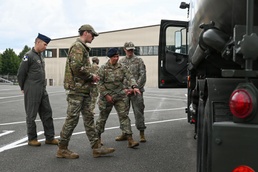
SPANGDAHLEM AIR BASE, Germany – There's a star at the center of a command chief's rank insignia, a clear distinction that sets the position apart from every other chief master sergeant on base.
What it represents, and what the special challenges this one-deep position entails, however, is something most Airmen rarely get close enough to see.
Chief Master Sgt. Mary Trent, 52nd Fighter Wing command chief, now wants to change that one Airman at a time.
She recently launched a mentorship program that lets Airmen follow her through a full day to witness the meetings, decisions, and conversations that shape the wing but rarely happen in front of the broader force.
"A command chief’s role is to empower our force at every echelon, driving the readiness, welfare, and professional development of every single Airman," Trent said. "I wanted them to see that commitment up close, not just to know it exists, but to understand what it truly takes."
Across the Air Force, command chiefs are the senior enlisted advisors to wing, numbered air force and major command commanders. They serve as functional managers for group superintendents and first sergeants and speak for the enlisted force on matters spanning training, morale, quality of life, and more.
As the wing's senior enlisted leader, Trent is the key advocate on operational effectiveness and proper utilization of every enlisted Airman assigned to Saber Nation — a personnel portfolio that underwrites the maintenance and support to F-16 Fighting Falcons fighter jets and roughly $6 billion in assets supporting U.S. and NATO missions across Europe.
Trent brings nearly three decades of experience to the job, entering the Air Force in 1996 as a security forces specialist and deploying several times in support of combat operations in Iraq and Southwest Asia, and steadily advancing through every level of enlisted leadership before assuming her current role at Spangdahlem in August 2024.
Airman 1st Class Joe Dorce, 52nd Fighter Wing Judge Advocate paralegal, was one of many to apply to the internship day. For Dorce, the experienced allowed him to follow the command chief from her first morning meeting to a working lunch, sitting in on senior leadership briefings, watching her field questions from commanders and Airmen alike, and observing the steady stream of decisions that fill a command chief's calendar.
"I learned a lot about her job, how difficult it is to be the bridge between enlisted and commissioned Airmen at that high of a level," Dorce said of his morning at the “front office.”
The pace never let up, either he recalled. The “Saber Chief” moved through the afternoon the same way she moved through the morning: No gap between the next meeting, the next decision, the next Airman who needed help or guidance from the person at the top of the enlisted chain.
"Spending the day with her showed me what it takes to be a leader at the wing level," Dorce added. "It wasn't easy. Even just keeping up with her for one day, I was exhausted by the end of it." While the intensity of the schedule was a primary takeaway for some, others found that the value of the experience lay in observing the administrative discipline and the personal approach Chief Trent brings to the wing’s "front office."
“As an Airman, I was surprised to see how rigid her schedule is,” said Airman 1st Class Faith Swicegood, 52nd Medical Group ophthalmic technician, another Airman who had shadowed the chief. “Seeing how she has things on her schedule months ahead really showed me how busy she is and how much work she has to do every day.”
The program is open to all Airmen as a window into the strategic-level decisions and responsibilities that come with increased rank. That visibility, Trent said, is the whole point.
“It was very eye-opening to see her at work,” Swicegood said. “She’s very authentic. Seeing her in a more relaxed work setting, in her office or talking about our personal lives, showed me a more personal side of the job and the rank that I never thought about.”
For junior enlisted Airmen, the experience doesn’t aim to intimidate but is designed to serve as an introduction to how the Air Force operates beyond their work centers and encourage them to think about long-term career opportunities earlier in their service, Trent said.
"I want Airmen to see how operations happen and start thinking early about what it takes to reach this level," she said. "What better way to envision being a command chief than to see what it’s really like?"
"I think it's an excellent opportunity to see what's going on," Trent added. "Even if you are just curious to find out what a day in the life of a command chief looks like."
Airmen interested in joining Chief Trent can sign up through their supervisor, first sergeant or senior enlisted leader, who will coordinate directly with the command chief's office for scheduling.