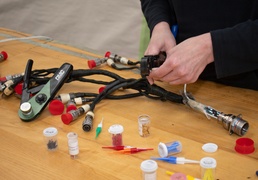
Tucked away from the roar of the flight line, Fleet Readiness Center East’s Cable Shop serves as the depot’s neurosurgeons, performing intricate surgery on the electrical “nerves” that bring aircraft to life. Whether they’re rewiring a five-mile-long wiring harness or manufacturing a new one from scratch, the team’s surgical focus ensures the fleet stays connected and mission-ready.
The Cable Shop provides the fleet with essential depot-level maintenance on aviation electrical components, cables and wire harnesses for the various weapons platforms maintained by FRCE. Wiring harnesses are bundles of electrical cables, wires and connectors that act as the nervous system, transmitting power, sensor data and signals throughout an aircraft.
Despite its small size, this three-person team repairs, overhauls and manufactures hundreds of wiring harnesses each year for the fleet. Serving as a specialized repair source for military aircraft wiring systems, the team performs repairs that go beyond standard fleet-level maintenance capabilities. By integrating these repairs with the facility’s manufacturing operations, FRCE’s Cable Shop provides military aviators with fully tested, ready-to-install hardware designed to minimize aircraft downtime and maximize mission operability.
These mission-critical assemblies are engineered to be modular, ruggedized systems that are capable of withstanding extreme environments, heavy vibration, and high G-forces. While the fleet can perform minor field repairs, such as terminal reconnections, the Cable Shop executes large-scale overhauls and intricate technical repairs required to maintain their structural and electrical integrity, according to the Cable Shop supervisor.
“These wiring harnesses are built to last, built to survive the hard missions,” the shop’s supervisor said. “Oftentimes, when harnesses are sent to us for repairs, it’s because of corrosion, water in the connectors, or repeat field repairs. While they are made with service loops so the fleet can fix a connection on the spot if needed, they can only be re-terminated so many times before they run out of slack. If the wire becomes too short, the whole thing needs to be replaced. That’s where we come in and redo the harness.”
The shop recently introduced an innovative repair solution that saves the fleet tens of thousands per instance on a wiring harness for the V-22 Osprey. This fix significantly extends the life of the harness by replacing a terminal lug with a more effective and durable version, eliminating the need to purchase a replacement. Terminal lugs are electrical connectors that attach to the end of a wire or cable to create a strong and secure connection between the wire and electrical terminals.
FRCE’s Cable Shop is also establishing the capability to test wiring harnesses for the F-35 Lightning II auxiliary power unit. Once established, this will be the first capability the Cable Shop has obtained for the F-35 platform, with plans to expand support in the future.
Repairing and manufacturing wiring harnesses requires expert precision as no two harnesses are identical, according to a Cable Shop electrical equipment repairer. Each wiring harness has unique requirements and technical standards the shop must follow, with varying levels of complexity.
“Wire is very important to keep aircraft flying. Every aircraft system has its own wiring system, each with its own wiring harness, all of which range from 26-gauge to 4-gauge wire,” said the electrical equipment repairer. “The H-53 right- and left-hand main wiring harnesses have over 25,000 feet of wire and coax cable in them, and those are only two of that aircraft’s wiring harnesses. There is also an electronics bay harness and aircraft flight control systems harness, and each contain about 10,000 feet of wire.”
“Attention to detail is critical because each wiring harness is different, and even the smallest deviation can have mission-critical consequences,” the electrical equipment repairer continued. “We have to remember which wire is terminated, where it runs, the size and kind of wire to use, how long it should be, and how and where to mark it–as well as whether it’s twisted or wrapped in a specific casing. It’s very important that we follow our technical drawings for the safety of our service members. Even something as easy as twisting it out of tolerance can cause it to fail.”
Beyond performing intricate repairs, the Cable Shop plays a vital role in the long-term sustainment of military aircraft. By repairing and manufacturing these complex systems with depot-level precision, FRCE ensures that mission-critical hardware is ready and available to meet the fleet’s needs. The shop’s ability to restore wiring harnesses to meet operational requirements not only extends the service life of various weapon platforms, but also provides the fleet with capable, combat-ready aircraft.
FRCE is North Carolina's largest maintenance, repair, overhaul and technical services provider, with more than 3,600 civilian, military and contract workers. Its annual revenue exceeds $865 million. The depot provides service to the fleet while functioning as an integral part of the greater U.S. Navy; Naval Air Systems Command; and Commander, Fleet Readiness Centers.