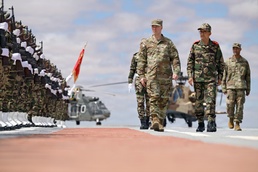
AGADIR, Morocco – After weeks of synchronized operations across land, air, sea, cyber, and space domains, African Lion 26 concluded with a series of complex, technology-driven culminating events that underscored the exercise’s evolution into the premier joint, all-domain multinational training event on the continent, May 8, 2026.
Led by U.S. Army Southern European Task Force, Africa (SETAF-AF), executed alongside Royal Moroccan Armed Forces and a coalition of more than 40 partner nations, AL26 demonstrated the scale, speed, and adaptability required to meet modern security challenges. The exercise brought together multinational forces, academic institutions, and more than 30 U.S.-based industry partners to test emerging capabilities in realistic, high-pressure scenarios.
“The capstone combined field exercise showcased the future of warfare through multi-domain vignettes, including defense in depth, deep strike operations, and a coordinated counterattack,” said U.S. Army Sgt. Maj. Patrick Jeffrey, G7 Directorate sergeant major, SETAF-AF. “By integrating artificial intelligence-enabled command and control, autonomous systems, advanced intelligence, surveillance, and reconnaissance, and unmanned aerial systems, we modernize and employ combat power.”
Those capabilities were put into practice across each phase of the exercise, demonstrating their impact in real-world scenarios.
“During the defense phase, layered networks of sensors, drone interceptors, and counter-UAS created a forward, tech-enabled bulwark that blunted enemy maneuver and preserved friendly forces,” Jeffrey said. “In the deep fight, special operations forces synchronized ISR, loitering munitions, and air-launch effects to dismantle adversary command nodes and air defense systems, opening corridors for precision fires. The exercise culminated in a combined counterattack, where remotely operated breaching systems and autonomous fire support platforms enabled maneuver forces to seize the initiative with reduced risk to personnel.”
Jeffrey emphasized that the exercise delivered effects beyond the battlefield it replicated, building on those tactical gains.
“What we accomplished during AL26 is readiness in action: realistic, joint, and multinational training that translated innovation into mission-ready capability,” Jeffrey said. “By combining rigorous academics, complex live fire events, and humanitarian outreach, we reinforced trust with our partners and proved we can operate together across every domain.”
Beyond tactical execution, AL26 served as a proving ground for integrating cutting-edge technologies directly into operational environments. Industry partners worked alongside service members to test AI-enabled systems, autonomous platforms, and advanced communications tools, accelerating the transition from concept to capability. “AL26 gave us an unprecedented opportunity to close the gap between emerging technology and the warfighter,” Jeffrey added. “Testing these capabilities alongside our partners accelerated decision making and shortened the kill chain, delivering tangible, battlefield-relevant effects to the combined joint force.”
The exercise also highlighted the enduring strength of the U.S.-Morocco partnership, rooted in more than two centuries of cooperation. U.S. Air Force Gen. Dagvin R.M. Anderson, commanding general of U.S. Africa Command, emphasized that the relationships built through exercises like AL26 remain the cornerstone of collective security. “As the United States celebrates its 250th anniversary, we are reminded that true strength is built not only on independence, but on the enduring partnerships we cultivate,” Anderson said. “The U.S.-Morocco relationship stands as a testament to that principle, a friendship that began in 1777 and continues to thrive today.” Anderson underscored that shared security challenges require unified action among partners.
“The threats we face today do not recognize borders, and neither can our response,” Anderson said. “From terrorism to transnational instability, these challenges demand a unified, multinational approach, one built on trust, shared responsibility, and the collective will to act decisively.”
Anderson noted that AL26 reflects the changing character of warfare, where success depends on innovation across multiple domains.
“No longer confined to land, sea, and air, the character of war is evolving rapidly,” he said. “African Lion serves as a laboratory for innovation, where we test, learn, and adapt in real time so we are prepared for the challenges of tomorrow.”
While the exercise demonstrated high-end warfighting capabilities, it also underscored the human dimension of partnership. During the event, multinational forces supported real-world search efforts, reinforcing the importance of trust and solidarity among allies.
“Though poignant, it is a tangible example of the partnership and friendship that this exercise represents,” Anderson said. “When tragedy strikes, our partners are there.”
Exercise leaders emphasized that readiness is not measured solely in capability, but in the strength of relationships built over time.
“We are grateful for the continued solidarity and tireless support of our Moroccan hosts as we work together through the most complex moments of this exercise,” Jeffrey said.
With participation from 28 African nations and 20 global allies, AL26 sent a clear message: multinational cooperation remains essential to addressing shared security challenges.
“African Lion is more than a training event, it is a demonstration of global partnership,” Anderson said. “Our shared commitment to a secure and prosperous Africa depends on our ability to work together, adapt to change, and act decisively to meet the challenges of the future.”
As AL26 concludes, the lessons learned from integrating advanced technology and strengthening multinational coordination will inform future operations and ensure that participating forces remain ready, resilient, and prepared to operate together in an increasingly complex security environment.