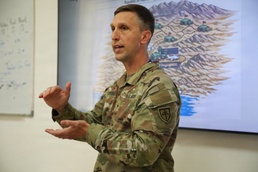
AGADIR, Morocco – African Lion 26 continues to strengthen military partnerships across Africa, and this year’s exercise introduced a new tool to advance that effort: the Assess, Advise, Advocate, and Integrate Operational Readiness and Sustainment Assessment. Instructors and trainers from the 79th Theater Sustainment Command helped lead the initiative, using the framework to close operational gaps and strengthen the enduring partnership between the United States and Morocco, April 20-May 8, 2026.
The A3I framework provides a structured method for evaluating and improving logistics systems across partner forces. During AL26, U.S. Army sustainment professionals partnered with Moroccan and other African officers to conduct operational logistics planning focused on real-world readiness challenges.
“We taught operational logistics planning using the A3I framework to assess the operational readiness and sustainment of our African partners,” said Hortordo M. Wilson Sr., future operations chief, 79th TSC. “This approach evaluates logistics capabilities, identifies gaps and measures progress toward mission accomplishment while fostering greater operational independence.”
The training emphasized practical collaboration over classroom instruction. Senior leaders worked together in planning environments where they assessed their own systems and exchanged ideas with partner nations. The process strengthened trust and interoperability between the United States and Morocco.
“This training gives both partners the opportunity to build trust, conduct joint planning, and gain experience planning at the operational level,” Wilson said. “That shared experience among senior officers is critical to strengthening relationships between our countries.”
The A3I framework directly supports the broader goals of AL26 by improving readiness, interoperability, and regional security cooperation under the leadership of U.S. Africa Command.
“The training directly supports the core intent of strengthening interoperability, enhancing readiness and reinforcing strategic partnerships to ensure security across Africa,” Wilson said.
The 79th TSC plays a key role in linking strategic resources to tactical operations. As an operational command post, the unit integrates capabilities that support both early-entry operations and long-term sustainment requirements across the theater.
“The 79th TSC’s specialized capabilities support both Defense Support of Civil Authorities and early-entry, set-the-theater requirements,” Wilson explained. “As the operational command post, the 79th TSC bridges the gap between the tactical and strategic levels by providing sustainment from the industrial base to the warfighter.”
As a U.S. Army Reserve unit, the 79th TSC also highlights the importance of readiness across all components of the force.
“The 79th TSC provides mission command and operational-level sustainment support to U.S. Africa Command,” Wilson said. “This training increases readiness and prepares Soldiers and units for worldwide operations and deployment.”
From a strategic planning perspective, the A3I framework gives partner nations a comprehensive approach to evaluating logistics operations. Benjamin Wilson, a USAFRICOM logistics planner and defense economics advisor, emphasized the long-term impact of the training.
“During this engagement, we’re conducting training on operational logistics using USAFRICOM’s A3I framework, which stands for Assess, Advise, Advocate, and Integrate,” he said. “The framework helps partner forces examine their logistics enterprise, from supply and maintenance to force readiness, infrastructure, resource management, and long-term sustainment. The goal is not simply to teach logistics concepts, but to help partners identify capability gaps and build systems that sustain readiness over time.”
The training also reflected direct feedback from partner nations, demonstrating a collaborative approach to multinational engagement.
“This training is a direct response to feedback from partner nations during last year’s West Africa Logistics Conference, where they requested more logistics-focused engagement,” Wilson said. “For Morocco and participating partner forces, it provides a structured way to evaluate logistics capabilities, identify priorities, and strengthen the ability to independently sustain military operations. For the United States, it strengthens interoperability, deepens trusted partnerships, and ensures we share a common understanding of readiness and sustainment during exercises, crisis response, and regional security operations.”
Sustainment remains central to long-term operational success because it enables military forces to maintain readiness over time.
“Sustainment is what turns military capability into lasting operational effectiveness,” Wilson said. “You can have trained personnel, modern equipment, and a solid operational plan, but without the ability to maintain, supply, move, and support that force over time, readiness eventually degrades. This training helps partner nations build resilient logistics systems, strengthen institutional processes, and develop the capacity to sustain readiness long after the exercise ends.”
As AL26 continues, the integration of the A3I framework demonstrates how deliberate planning, shared expertise, and mutual respect produce tangible operational results. Mark F. Schoenfeld, deputy commanding general of 79th TSC, emphasized the importance of connecting sustainment efforts across all levels of partnership. “It all must be connected or it doesn’t work,” Schoenfeld said. “This exercise is a great example of that. Mutual understanding and shared experience built on respect are extremely important. You may never see those things on a slide, but the results will show up in troops fed, vehicles fueled, and ammunition delivered.”