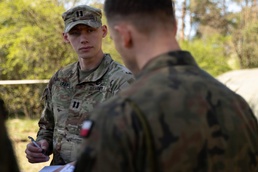
Bemowo Piskie, Poland — Prior to entering the safety tower, the role of U.S. Army Capt. Seth Evans, fire support officer for 2nd Cavalry Regiment (2CR), was to coordinate with the Polish artillery soldiers and fixed wing pilots for the fire support coordination exercise (FSCX) at Bemowo Piskie Training Area in Poland on May 7, 2026.
The 2nd Cavalry Regiment trained as they fought during exercise Saber Strike, a part of Sword 26, in which nearly 15,000 troops from eleven nations will train across the High North, Baltic region, and Poland. Alongside 2CR Apache Helicopters, tanks from the Polish Armed Forces and Polish fighter jets. But some roles did not involve moving a vehicle or flying an aircraft. They stayed static in a rectangular room, filled with a single line of desks with laptops and radios, busy throughout the 41 hours of exercise.
“We were able to deploy and synchronize effects from Polish F-16s and K9 Thunder artillery in conjunction with U.S. M777A2 (Howitzer) artillery, 120 mm and 81 mm mortars, and one-way attack drones to strike multiple high-payoff targets simultaneously,” said Evans.
The day of the exercise, one could hear gunfire, artillery blasts, roaring jets, helicopter and drone blades spinning as platoon after platoon of Strykers rolled onto the range to engage a notional enemy approaching. Each sound on the battlefield played an essential role during the exercise, but some sounds were only heard on the radios.
On the radios, Soldiers served roles as safeties and logistical support up in a four story tower at the front of the range. These Soldiers verified rounds fired, communicated with aviation units and coordinated movement in the skies above the training area.
Drones were up in the air verifying target accuracy, performing reconnaissance and one-way attacks, while Apache helicopters flew by the tree line blasting rounds down the firing lane.
U.S. Army Staff Sgt. Samori L. Odom, regimental aviation operations non-commissioned officer for 2CR, said, “We try to make this as seamless as possible so that it confuses the enemy, because they were just getting hit from the front, and then they get hit from the side by Apaches.”
Odom has been the regimental aviation coordinator for three years. His role during the exercise was to verify that the air spaces were clear.
To create an airspace operating picture, Odom says it looks like “breaking it down by different grids, and literally making sure that airspace is not only laterally but vertically deconflicted.”
He also had to coordinate with the Polish Armed Forces on the range. Once the Polish tanks ceased firing, he was able to allow the Apaches to fly in and shoot missiles onto the targets or notional enemies.
Alongside Odom were joint fire observers for the FSCX during Saber Strike. Their role was to observe live fire rounds, control and pass relative targeting information to the Apaches.
“We’re observing live fire artillery rounds to make sure they land safely for the live-fire event,” said U.S. Army Sgt. Anthony Nightingale, joint fires observer assigned to Delta Battery, Field Artillery Squadron, 2CR. “We’re also providing another element of deconfliction for aircraft to mass both indirect and direct fire in a scenario.”
Nightingale explained that he was passing notional target data to get a situational report as to what he would actually do if he was out there on the line.
“The exercise demonstrated 2CR’s unique ability within NATO to rapidly deploy, build combat power, and integrate new systems that translate into real-word effects,” said Evans.
For 2CR to demonstrate this capability, every element had to execute its role successfully during the FSCX’s day and night operations: platoons engaging targets from their Strykers downrange, drone operators in flight, pilots in the air and tower personnel coordinating over the radio.
U.S. Soldiers and Allied partners dedicated themselves to whichever role they were assigned, whether it be on the notional battlefield or working in the tower.
Evans said, “The training here at Saber Strike 26 was highly successful and highlighted the strength of NATO interoperability and the combat power generated through allied integration.”