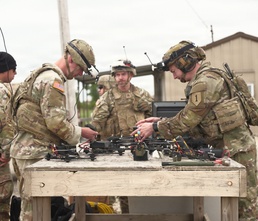
1st Infantry Division Soldiers Demonstrate Drone Anti-Armor Capability
FORT RILEY, Kan. – U.S. Army Soldiers from Delta Company, 1st Brigade Engineer Battalion, 1st Armored Brigade Combat Team, 1st Infantry Division, ushered in a new era of warfighting during a demonstration of a first-person view drone system capable of delivering anti-armor munitions for Big Red One senior leaders at Fort Riley, April 29, 2026.
The demonstration marked the culmination of a months-long development effort that transformed a concept into a live-fire capability, integrating the Selectable Lightweight Attack Munition onto a low-cost FPV drone frame.
The company has several experienced FPV drone operators, though its current drone inventory is primarily focused on reconnaissance. Leaders identified a capability gap in integrating munitions with existing drone platforms, driving the effort to develop an armed FPV system. "It really started with our battalion commander challenging us to get creative with the gear we already had," said Capt. Kyle Fortin, the Delta Company commander. "We knew we had a gap in capability, so we put our heads together and mounted a SLAM onto a cheap, purpose-built FPV drone to give the unit an organic anti-armor option. We turned a passive explosive into an active hunter."
On the day of the demonstration, a three-drone system was employed in sequence. Two observer drones took flight first, maneuvering to identify and confirm a stationary armored-target downrange. Once both observer pilots relayed that the target was set, Chief Warrant Officer 2 Nathan Dvorak, the Delta Company’s small Unmanned Aerial Systems chief, launched the SLAM-equipped FPV drone. Dvorak guided the aircraft to altitude above the target, received final clearance from his observers, executed a top-down strike and detonated the SLAM against the armored target. The system gives commanders an attack angle not previously available to them with standard drone configurations. Engaging the most vulnerable surfaces of an armored vehicle from above, without placing a soldier in direct contact. Delta Company’s development of the SLAM enabled drone began in September 2025. The process required extensive testing before any live fire could take place. According to Dvorak, the team worked through static tests, electronic testing with light-emitting diode fixtures and progressive ignition system trials before executing the live demonstration.
Staff Sgt. Jacob Owens, a UAS operator and squad leader with Delta Company, led much of the hands-on construction and training effort. His team built multiple drone kits and developed an internal training pipeline modeled after formal FPV coursework, progressing soldiers from flight simulators to live aircraft before advancing to armed operations.
“Now that we have the framework in place to actually use the SLAM round … we can hopefully get our guys on the systems more often,” said Owens. The unit's collaboration extended beyond its own formation. Advisers from the 10th Special Forces Group, 19th Special Forces Group, Joint Multinational Readiness Center, Kraken Kinetics and Mountain Horse Solutions contributed real-world insights and technical support throughout the development cycle. Fortin prioritized safety throughout the development and testing process, helping the unit secure an Army Test and Evaluation Command safety release for the experimental configuration during a demanding training period.
“The cost of the system reflects its broader strategic value,” said Fortin. “A single SLAM-equipped FPV drone system costs approximately $5,700, compared to more than $120,000 for a Javelin missile, offering tactical units an organic, low-cost option against armored threats without drawing from high-end munitions stockpiles.” “The project is a direct answer to that call,” said Fortin. “Demonstrating that tactical units can develop, test and field relevant technology in a matter of months rather than years.” The effort aligns with Executive Order 14307 directing units to accelerate the fielding of drone capabilities. The directive enables commanders to pursue strategic modernization through actionable tasks at the unit level. “We didn’t spend billions inventing a brand-new system,” Fortin said. “We took American ingenuity, grabbed a highly reliable U.S. munition we already have in the stockpile, and combined it with off-the-shelf drone tech.”
The unit has identified future goals that include integrating additional munition types, pursuing dedicated range safety protocols to enable more frequent live-fire training and building a robust in-house training pipeline equipped with 3D printers and flight simulators. “By strapping an existing Army munition onto a drone, we aren't waiting years for a new procurement cycle," Fortin said. "We're ready to fight tonight." -30-