JOINT BASE-ELMENDORF-RICHARDSON, Alaska— U.S. Air Force explosive ordnance disposal technicians from Joint Base Elmendorf-Richardson and first responders from Alaska recently gathered on April 30 for advanced unmanned aircraft systems (UAS) training to enhance interoperability and operational safety.
The curriculum featured classroom instruction and hands-on training for deploying drones in various high-stakes scenarios, such as missing person and article searches and building clearings.
“Training on UAS for search and rescue (SAR) and indoor drone tactics isn’t just a ‘nice to have’ anymore. It’s quickly becoming a core capability for modern policing and public entities,” said Lt. Michael Lopez, a Wasilla Police Department officer. “The value shows up in safety, efficiency and operational reach.”
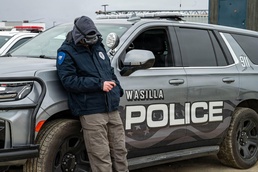
Wasilla PD hosted Public Safety UAS for two, two-day drone courses focused on SAR and indoor UAS operations. The four days of instruction were split evenly, with two days dedicated to search and rescue operations and two days focused on indoor tactical training.
Tim Curry, Public Safety UAS SAR team lead, emphasized the critical nature of keeping operator skills sharp across both disciplines.
“Training is always important no matter what you are doing,” Curry said. “If you don’t rise to the occasion, you could put people’s lives at risk.”
A major focus of the event was using indoor drone tactics to fill capability gaps. While traditional drones excel outdoors, indoor environments such as schools, warehouses and active crime scenes are often where individuals are most vulnerable.
Training indoors allows teams to navigate tight GPS-denied spaces, map environments in real time and locate threats without making an immediate physical entry.
“Using drones to clear structures or search hazardous environments reduces the need to send officers into unknown threats,” said Lopez. “Whether it’s a barricaded suspect, a collapsed building or a hazardous materials scene, a drone can provide real-time visuals before anyone steps inside. That lowers the risk of ambush, exposure or injury.”
For JBER personnel, the technology offers similar life-saving advantages, particularly for EOD operations.
“Being able to put eyes on an object without putting Airmen in harm's way is a big part of this training,” said Curry.
Lopez agreed with Curry, noting that EOD personnel can use drones to investigate scenes instead of exposing service members to risks.
Beyond tactical and military applications, the drone training heavily emphasized search and rescue operations, a vital mission in Alaska's vast and harsh terrain. Drones equipped with thermal imaging can cover large areas quickly and access terrain that would normally slow down ground teams, preserving manpower.
“In search and rescue, drones help us find missing people faster, often making the difference between life and death,” said Lopez.
In addition to tactical and rescue uses, drones offer a new level of precision for scene documentation and evidence collection. High-resolution aerial imagery captures full scenes, vehicle positions and spatial relationships with extreme precision, allowing investigators to create 3D models and reopen roadways quicker after serious vehicle collisions.
Firefighters, emergency medical services, military and other public safety partners are using drones to build a shared playbook for large-scale incidents, such as natural disasters or mass casualty events, ensuring that multiple agencies can operate effectively together.
“We are finding new uses every day,” said Curry. “It is only limited by the imagination. We have used them on house fires, high risk search warrants, barricaded subjects, and search and rescue missions. You name it, a drone can probably help.”
As drones become fully implemented across operational environments, ongoing joint training remains essential to ensure the technology is used safely, legally and effectively.
“Drones are no longer the technology of the future,” said Lopez. “They are prevalent on the battlefield and provide significant benefits to all manner of public safety responders. Drone technology will continue to develop, and we need to keep pace to best leverage its benefits.”