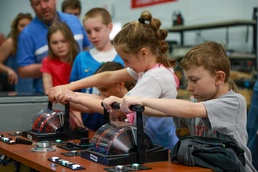
For one morning, Naval Surface Warfare Center, Philadelphia Division’s (NSWCPD) test sites, labs, and workspaces buzzed with a different kind of energy. The command hosted its annual Take Our Children to Work Day on April 23, welcoming nearly 500 children for a day focused on family, mission, and discovery.
There were questions. A lot of questions. As children spent the morning trying hands-on experiments, watching demonstrations, touring the places where their parents work, and getting a closer look at how engineering, science, contracts, cybersecurity, and ship systems directly support the Navy and its Sailors.
Throughout the morning, families participated in activities and tours across the Philadelphia Navy Yard. In one building, children explored fluid dynamics and heat transfer, played a cybersecurity card game, built electrical circuits, created visible and audible waves in acoustics demonstrations, and learned about fair pricing through a “Price is Right” activity led by the Contracts Department.
In other buildings, families toured labs and test sites for submarine life support, hydrostatic pressure testing, and towed communications, along with labs dedicated to keeping aircraft carrier machinery and environmental systems running smoothly.
The point was not just to show children the equipment. It was to show them the possibilities.
For Lance Shappell, Auxiliary Ships/Acquisition Support Branch Ship to Shore Connector Deputy Ship Design Manager, the day gave his daughters a chance to see engineering as something real, active, and exciting.
While one daughter said she liked “seeing the cool stuff,” her sister, was more direct and asked questions during a tour of a hydrostatic pressure test tank.
“I like engineering,” she said.
Shappell said that kind of exposure matters.
“It gives them exposure to a variety of engineering and sciences,” Shappell said. “They get to see that there are many different ways to solve problems and support the Navy.”
That was also part of the message from Mechanical Engineer Kaitlyn Hines, who helped lead children through the hydrostatic pressure test tank demonstration.
“Being the first engineer in my family, this is great because kids get to see STEM up close,” Hines said. “They get to see that engineering is not just something in a textbook. It is something people do here every day.”
At the Tow Cable Test Site, Mechanical Engineer Thomas DiMario led a demonstration comparing a nylon cable and a hemp rope to see how many pounds of force each could withstand before snapping. Before the test, children guessed which sample would break first. Then they watched as the test fixture applied tension to the materials.
Children of Thomas Fien, Remote Monitoring and Condition Based Maintenance Branch Manager, were among those watching closely.
His son said he came hoping to learn about submarines. “I think it is kind of cool the way they operate and the systems the submarines have,” he said.
Fien said this was the third year his children attended the event, but the first year they signed up to see the labs.
“I want them to have fun and to learn,” Fien said.
At his test facility, Matthew Chin, Mechanical Engineer at the Environmental Quality Systems Land-Based Test Facility and a former graduate of the Department of War’s Science, Mathematics and Research for Transformation (SMART) scholarship program, demonstrated how the Navy works to prevent oil from discharging into the ocean.
Chin said he enjoys sharing new concepts with young people, especially when it helps them see science, technology, engineering, and mathematics (STEM) as something they can pursue.
“I enjoy getting kids and students interested in STEM and the SMART program,” Chin said. “When they see these systems and ask questions, it helps them understand that science and engineering can be used to solve real problems.”
For some students, the day was also about narrowing down what might come next.
James Vaites, Navy Electronic Charting Display and Information System (ECDIS) Technical Specialist brought his daughter, a high school sophomore, to tour his work area in Electronic Chart Systems.
“It was lots of numbers,” his daughter said with a smile.
But the numbers did not push her away. They made her curious.
“I don’t know what I want to do in college, so this gives me exposure to a lot of the different sciences and engineering,” she said.
The son of Brian Edwards, Towed Communications & Advanced Undersea HM&E Project Manager, said the day gave him a better understanding of the people behind the work.
“I like how everybody is able to explain in depth what they do and to see what my dad does,” his son said. “I will leave with a better understanding of his role.”
That may be the truest measure of NSWCPD's Take Our Children to Work Day, not just the awe of watching a cable snap under tension or the wonder of a lava lamp made with cooking oil, and Alka-Seltzer that shows why oil and water don't mix, but the moment a young visitor looks at a Sailor, a scientist, or an engineer and thinks:I could do that.
For Natalie Williams, Carrier, Submarine and Cross-Platform Modernization Cost/Price Analyst and Contracting Officer, the event had already proven its value. Her son attended last year and asked her to return.
“He enjoyed it so much last year that he wanted to come back,” Williams said.
That return visit is what organizers hoped the day would accomplish. That sentiment was shared across campus, serving as a testament to the quality of the programming. It also reflected the pride NSWCPD's workforce takes in showing the next generation what public service and technical excellence look like from the inside.
Take Our Children to Work Day gave families a chance to spend time together and helped children connect their parents’ work to something larger. They saw circuits light up, watched materials break under pressure, and learned how the Navy manages wastewater, oil, damage control, charts, control systems, and shipboard machinery. They saw that the work done in Philadelphia helps Sailors, supports readiness, and serves the Nation. They also saw that the people doing the work were not distant figures in lab coats or behind computer screens. They were moms, dads, aunts, uncles, engineers, scientists, contract specialists, project managers, and technicians who could explain complex systems in ways children could understand.
For NSWCPD, that may have been the day’s most important demonstration. The command opened its doors, showcased its mission, and gave the next generation a closer look at how curiosity can become service. For nearly 500 children, the Navy’s work in Philadelphia became a little less abstract, a little more exciting, and a lot closer to home.
NSWCPD employs about 2,700 civilian engineers, scientists, technicians, and support staff. The team focuses on research and development, testing and evaluation, acquisition support, and in-service and logistics engineering for non-nuclear machinery, ship machinery systems, and related equipment and materials for Navy surface ships and submarines. NSWCPD also serves as the main organization responsible for providing cybersecurity for all ship systems.