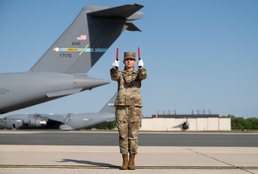
U.S. Air Force Staff Sgt. Madyson Hodges serves in one of the most solemn and meaningful missions in the military—honoring fallen service members and supporting their families during unimaginable loss. As a Dress and Restoration specialist assigned to Air Force Mortuary Affairs Operations (AFMAO), her work requires precision, compassion, and quiet strength. In this “Meet the Deployer” spotlight, Hodges shares her personal journey, the weight of her responsibility, and the purpose she has found in service to others.
What were your initial thoughts or feelings when you received your assignment to Air Force Mortuary Affairs Operations?
“When I first received the call about my assignment to AFMAO, I was honestly nervous. I had just graduated college and was ready to start a new chapter—settle into a routine and begin my career close to home. I didn’t want to move hours away from my family and friends for six months to do such a difficult job alone. But after talking to Airmen in my unit who had been to AFMAO, my perspective changed. They told me it would impact me both personally and professionally. Looking back now, they were absolutely right—this experience has changed my life for the better.”
Can you describe your role and what a typical day looks like for you and your team?
“I serve on the Dress and Restoration team, where I prepare fallen service members for their final viewing with family and loved ones. On days when we have a dress, we start by preparing the room, then carefully dress the service member, which takes several hours. On days without an active case, we train to improve our processes and stay sharp. We also support other areas within AFMAO, like learning carry team procedures and helping train Army 92Ms on Dignified Remains (D&R) functions.”
What is the biggest misconception people have about the mission you perform here?
“The biggest misconception is how much intricate detail goes into everything we do. Every step in the D&R process is followed exactly, using a checklist to ensure nothing is missed. Each fallen service member is treated with the highest level of honor. From how we move them, to how their uniform is worn, to even a speck of lint—every detail matters. Nothing is done without precision.”
The AFMAO mission is centered on providing “Dignity, Honor, and Respect” to the fallen and “Care, Service, and Support” to their families. What does that mantra mean to you personally?
“To me, it means no one is left behind. The fallen are not forgotten after their sacrifice—they are cared for with intention long after the moment of loss. It’s our responsibility to give that respect back to them. At the same time, we recognize the immense grief their families carry. That loss should never go unseen. We’re here to support them, to acknowledge their pain, and to make sure they know their loved one’s sacrifice matters. Both the fallen and their families deserve that care equally.”
What is the most challenging aspect of serving in this environment?
“The hardest part can be processing what some of the fallen may have experienced before their death. Every service member has their own story, and it’s easy to start asking why things happened the way they did. When that happens, I remind myself of my purpose—to care for them now. I may not be able to change what happened, but I can ensure they are treated with dignity and respect.”
What has been the most rewarding or fulfilling moment during your deployment?
“The most fulfilling part is being part of something so much bigger than myself. It’s easy to get caught up in everyday life, but this mission puts everything into perspective. When I am here, every day I am contributing to a goal that is much larger than any normal daily task or job. It’s challenged me in ways I’ll carry with me forever and has connected me to a deeper purpose than anything I’ve experienced before.”
How do you and your fellow Airmen support one another through the difficulties of this duty?
“What helps most is having someone who understands. Some days are heavier than others, and it’s not always easy to explain this work to people outside AFMAO. The people here get it. Whether it’s a conversation, a text, or just sitting together, they’re always there to listen. That support system is everything when it comes to processing what we experience.”
How has this experience changed your perspective on military service and life?
“It’s shown me just how short life is. At any moment, in any situation, everything can change. It’s made me want to love people more openly and appreciate every single day. Every morning is another chance to be grateful, to make someone smile, and to experience something new. If we don’t make today count, time will pass us by faster than we realize.”
Is there a particular moment that has had a lasting impact on you?
“My first Dignified Transfer will stay with me forever. It was at night on the flight line, and as we marched onto the aircraft and I saw the flag-draped transfer case, everything became real. I had goosebumps. That was the moment I realized I was part of something so much bigger than myself. I understood then that these six months wouldn’t be about me—it would be about honoring every fallen service member entrusted to our care.”
What is the most important thing you want the public to know?
“I want people to know that the fallen are never forgotten. Each name represents a life, a story, and a sacrifice that stays with me. It is an absolute honor to serve here. I truly believe I was placed here for a reason, and this is something I will carry with me for the rest of my life.”
Through her time at AFMAO, Staff Sgt. Hodges has gained more than professional experiences, she has developed a deeper understanding of sacrifice, service, and the value of every moment. Her story reflects the dedication of the Airmen who carry out this sacred mission each day, ensuring that no fallen service member is ever forgotten and that every family receives the care and respect they deserve.