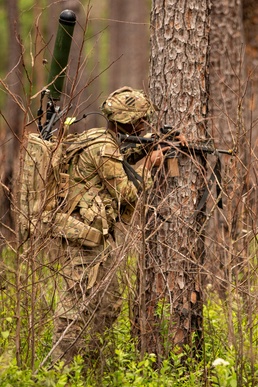
FORT STEWART, Ga. — Soldiers assigned to the 3rd Infantry Division (3rd ID) are adapting to a battlefield that is becoming more crowded, more connected and more difficult to hide in as drones and electronic warfare continue to change how wars are fought. During training at Fort Stewart, scouts, drone operators and electronic warfare (EW) Soldiers worked together to build reconnaissance capabilities designed for today’s increasingly congested battlespace — an environment filled with unmanned aircraft systems (UAS), radio traffic, electronic signatures and constant surveillance. “We always want to make contact with the enemy through a sensor and not through finding the enemy with a human being,” said Capt. Robert Seals, commander of Charlie Troop, 5th Squadron, 7th Cavalry Regiment, 1st Armored Brigade Combat Team, 3rd ID. “If we can make contact with drones, we can buy more reaction time and maneuver space for the brigade commander.” Leaders throughout the division said lessons learned from current conflicts continue to shape how units train. Drones, EW systems and digital communications now play a major role in nearly every aspect of battlefield operations. According to Seals, the modern battlefield is saturated with electronic devices and signals, forcing units to rethink how they communicate, move and conceal themselves. Soldiers must now consider everything from drone detection to radio discipline and signal management while operating in the field. That shift has changed the way reconnaissance units operate. Instead of relying solely on traditional observation methods, formations are integrating UAS and EW capabilities down to lower levels so platoons and companies can react faster and gather information more effectively. Lt. Col. Jonathan Roland, commander of 5th Sqn., 7th Cav. Regt., 1st ABCT, 3rd ID. said reconnaissance now extends beyond physical terrain and into the electromagnetic spectrum. “Today’s leaders have to account for point A to point B, C, D, E and F,” Roland said. “It creates a congested problem set that our leaders have to navigate.” EW Soldiers supporting the squadron said the growing use of drones and radio systems has made communication discipline more important than ever. “It’s made radio etiquette less of a formal issue and more of an actual battlefield issue,” said Sgt. Griffin Quimby, an EW Soldier assigned to 1st ABCT, 3rd ID. “Now you have to communicate less on the battlefield so the enemy EW can’t see you.” Drone operators within the formation said unmanned systems allow units to scout ahead of maneuver forces, identify enemy positions and provide commanders with real-time information before Soldiers move into danger areas. “It allows them to have that advanced notice of potential enemies they’re going to run into,” said Sgt. Ian Anglin, a UAS operator attached to 1st ABCT, 3rd ID. “It allows them to live, to survive.” The terrain at Fort Stewart adds another layer of complexity to the training. Thick vegetation, swampy ground and limited visibility force Soldiers to adapt while operating in difficult conditions that leaders say mirror many of the challenges found in real-world environments. As technology continues to evolve, leaders across the division said innovation from junior Soldiers will play a key role in preparing the force for future conflicts. Whether developing new drone tactics or finding ways to counter enemy electronic warfare systems, Soldiers are being encouraged to experiment, adapt and learn during every training event. For the Soldiers training at Fort Stewart, the congested battlespace is no longer a future challenge — it is the reality they are preparing to fight in today.