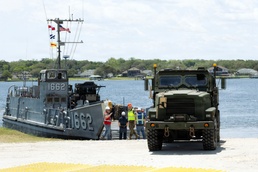
U.S. Marines with the 22nd Marine Expeditionary Unit (Special Operations Capable) landed an up-armored wrecker May 5 at Marine Corps Support Facility Blount Island in Florida, demonstrating how the service rapidly moves equipment to support operations across the region.
The six-wheeled recovery vehicle was transported aboard a landing craft utility designed to move heavy equipment from ship to shore. The craft departed the San Antonio-class amphibious transport dock USS Fort Lauderdale (LPD 28) and transited along the St. Johns River to Blount Island.
After the vehicle rolled ashore, the LCU departed the slipway, completing the ship-to-shore movement. The rapid response enabled the MEU to stage equipment without delay, reinforcing the Marine Corps’ ability to sustain forces operating in the U.S. Southern Command area of responsibility.
“Blount Island Command consistently gave us a responsive option to move equipment ashore quickly and keep our operations on timeline,” said Marine Corps Capt. Ben Peinsipp, 22nd MEU (SOC) logistics planner.
Blount Island Command coordinated the landing immediately after the unit requested support while operating in the Caribbean.
“This is what we’re built for—ready to support Marines when they need it,” said Master Gunnery Sgt. Garrett Mitchell, chief of operations at Blount Island Command, standing beside the slipway as the LCU approached shore. “Our job is to enable ship-to-shore operations quickly so Marines can keep moving.”
Located about 8 miles inland along the St. Johns River, Marine Corps Support Facility Blount Island supports maritime logistics and amphibious landings independent of tidal constraints, enabling equipment transfer when and where it is needed. A sand ramp at the slipway entrance enabled the LCU to land and transfer equipment efficiently, supporting responsive operations for Marines in the region.
The operation reflects continued support to Marine forces in SOUTHCOM. In a similar response to the MEU in October, Blount Island Command fulfilled an urgent requirement for armored vehicle windows within hours, pulling and shipping panels from its Jacksonville-based stocks to reduce procurement time and cost while reinforcing regional logistics readiness.
“Whether coordinating ship-to-shore movements or sourcing critical parts on short notice, their support enabled us to maintain momentum across the U.S. Southern Command area of operations,” said Peinsipp. “That level of flexibility directly sustained the MEU’s readiness and ensured we could continue maneuvering without delay.”