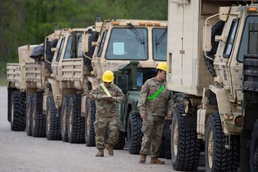
For members of the 302nd Inland Cargo Transfer Company (ICTC), or really any ICTC, annual training provides the opportunity to flex their muscles in demanding, high-tempo environments. Whether being evaluated or not, annual training relies heavily on the ability to load or offload equipment for the exercise.
For the 302nd ICTC, now conducting their mission at Guardian Response, it's no different. As the senior enlisted leader for the 302nd, 1st Sgt. Jones understands the importance of the ICTC’s mission and insists on getting “the why” down to the lowest level:
“I try to let the Soldiers know that this mission depends on us.” “I try to make them get the bigger picture of why we're here, and to keep them mission-ready.”
“We need to really focus on what we're doing because the civilian population, their livelihood, their children, their houses, their jobs, all depend on how we react in the event of a catastrophe. So I tell the Soldiers they should take pride in participating in it.”
“I wanna say that it's an honor to be a part of this mission.”
One of the things that makes our Army Reserve force so powerful is, of course, the people. Reserve Soldiers have civilian careers that don't always align with their military specialty. That’s not the case for 1st Lt. Rondy Phipps, an 88A Transportation officer currently working as the 302nd’s CRISP yard OIC. Phipps has a Doctorate in Management and, while working for Walmart, trains managers across the East Coast in leadership.
Phipps, who looks to stay in the military for the long haul, has enormous value to the Army Reserve and is only one example of the power that Army Reserve Soldiers bring to the fight, often bringing skills that undoubtedly make the organization more lethal.
“I'm enjoying my time here at Guardian Response and enjoy bonding with the Soldiers. This is one of the few situations where I get to spend time with the Soldiers and actually see them demonstrate their expertise.”
Annual training also provides an opportunity to exercise contingency plans. The ability to pivot from electronic systems to more rudimentary methods becomes essential when working on the modern battlefield.
For Sgt. Sapphire Uzzle, an 88N from the 302nd, this is a scenario she is currently training Soldiers for. Although she has mastered electronic tracking methods while deployed to the EUCOM theater, she can conduct her unit's mission with pen and paper if needed.
“Sometimes code scanners die. Sometimes the scanners reject the TCN on the shipping labels. Sometimes there aren't any shipping labels. So that's when we have to go back to hand jamming it.” So, “the newer Soldiers at this exercise are learning how to do it the manual way, so that if the scanners do go down or if they don't work for whatever reason, they know how to do their job.”
“We can get out, go put eyes on the equipment, do a yard count, walk through, and make sure that the numbers that we have here actually match what's going on in the yard.”
Sgt. Uzzle’s attention to detail and stewardship of the accountability process speak highly of her character. Sgt. Uzzle is currently working on her degree in behavioral health science with a focus on trauma.