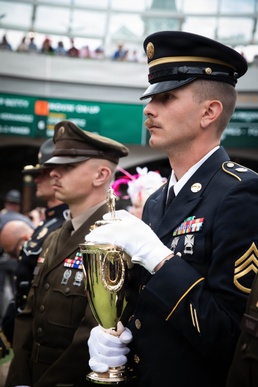
LOUISVILLE, Ky. – On the evening of May 2, 2026, the trophy felt heavier in Staff Sgt. Jonathan Miller’s memory than it did in his hands.
He recalled the 150th Kentucky Derby two years prior, when he crossed the turf at Churchill Downs with a single thought on loop: “You’re almost at the podium. You’re almost at the podium.”
At the time, his focus was locked on his task. He knew a single misstep could lead to a lifetime of regret. He was carrying one of the most recognizable icons in American sports before thousands of spectators, cameras and a global television audience: the Kentucky Derby Trophy.
“It was the most nerve-wracking day of my entire life,” Miller said. “A lot of eyes on me that day.”
This year, Miller returned to Churchill Downs for the 152nd Kentucky Derby. He was not the Soldier at the front of the formation this time; he was the noncommissioned officer in charge (NCOIC) of the trophy detail.
As a military police Soldier assigned to the 617th Military Police Company, 198th Military Police Battalion, Miller led the joint-service team responsible for guarding and escorting the Kentucky Derby trophy throughout Churchill Downs before its final movement to the winner’s circle.
“The trophy detail escorts the trophy around Churchill Downs,” Miller said. “You provide security for it, making sure no civilians lay their hands on it because it’s incredibly valuable and meant only for the Derby winner.”
The mission was straightforward: keep the trophy secure, maintain the schedule and project military professionalism. Miller’s team operated as one element of the Kentucky National Guard's broader support framework at Churchill Downs, which included 131 Guardsmen operating throughout the weekend. Soldiers from the 198th provided law enforcement augmentation at access and traffic control points, while the 41st Civil Support Team conducted specialized security monitoring. Additionally, the Joint Operations Center established a mobile command post to coordinate interoperability between military personnel and civil authorities.
For Miller, the significance went beyond the object itself.
“It’s not just significant to the Derby, it means a lot for us in the detail too,” he said. “We show up, we work hard to protect the trophy, and we carry ourselves with confidence and pride. And what better way for them to show love to our military than to let us do this?”
Miller’s day began long before the public was welcomed to Churchill Downs, starting with a comprehensive brief to ensure everyone understood the task, conditions and standards.
“We get here really early, get everyone together and do a kind of rundown of the whole day together with hit times and where the trophy is going to move to,” Miller said. “We make sure we’re on the same page so we can abide by that schedule.”
Once briefed, the team put the plan into action. They moved to the museum where the trophy was kept, then escorted it to the Director’s Room. From there, Service members rotated through guard positions in short shifts.
Miller said the frequent rotations helped prevent fatigue while ensuring the trophy was never left unsecured. It also allowed the team to stay sharp as the trophy moved throughout Churchill Downs for guests to see and photograph before its final ceremonial escort to the winner’s circle.
As the NCOIC of the joint-service team, Miller was responsible for Service members across multiple military branches. He oversaw drill and ceremony, coordinated movements and made sure the team maintained military bearing while still getting food, breaks and time to reset during a long day at the track. Miller was quick to adjust when needed, often taking on additional duties and work to ensure the trophy was cared for and protected, along with the Soldiers, Airmen and Marines under his leadership.
The Army traditionally carries the trophy at the front of the formation, with other services following as part of the ceremonial movement. Miller carried the trophy during the 150th Derby, but this year, that moment belonged to younger Soldiers.
“This year, I’m letting our lower enlisted Soldiers take care of it,” Miller said. “They’ll get to carry it out to the track this year, and they’ll be in the same shoes I was in during the 150th race.”
That decision came from experience. Miller said his own turn carrying the trophy remains one of the most memorable moments of his military career. At the time, he was representing the 940th Military Police Company. He remembers the nerves, the crowd and the need to keep moving.
“I felt really honored,” he said.
Miller was selected to lead the detail this year because of that prior Derby experience, his rank and his ceremonial background. He regularly serves details rendering Military Funeral Honors – where precision, discipline and bearing are essential.
“They thought I’d make a good fit and put me in charge of the detail,” he said.
The Derby is not the reason Miller joined the Guard, but he said it has become one of the clearest examples of why service matters to him.
Miller grew up in Northern Kentucky and attended Silver Grove Independent School before it closed. He later studied fire, arson and explosion investigation at Eastern Kentucky University before joining the National Guard. He also served as a volunteer firefighter with Campbell County Fire Department and said he hopes to work in law enforcement on the civilian side.
He said he chose military police because he wanted a role that offered strong post-military opportunities.
“I wanted something that translated directly back to the civilian world,” Miller said. But his reason for joining was broader than a career path; rather, it was a desire he had for as long as he could remember.
“I’ve always wanted to do something bigger than myself,” he said.
Although Miller considered the Air Force or Navy in high school, his stepfather encouraged him to first utilize the education path already available to him.
“During college, that desire to be a part of something bigger never went away,” Miller said. “I wanted to get outside Kentucky, so I joined the National Guard and became a military police Soldier.”
Nearly nine years later, Miller said serving in the Guard has become a source of pride, especially since becoming an NCO.
“I get to develop Soldiers like others who had developed me,” Miller said. “It’s eye-opening, humbling, and it makes me feel proud of myself. I feel like I’m doing something good for myself, my fellow Soldiers, our state of Kentucky and my country.”
Miller said that visibility matters. Service members working the Derby are not only supporting a major event; they are showing other Soldiers and the public what military service can look like in their own state.
“A lot of other Soldiers can see what we’re doing and think, ‘I want to be a part of that,’” Miller said. “That can help with retention or give people interest in enlisting, just from seeing us at the Derby carrying the trophy and thinking, ‘Man, I want to be the guy who does that.’”
For Miller, the Kentucky Derby has changed from something familiar to something personal. Growing up in Kentucky, he knew about the race and watched it, but he said he did not fully appreciate its scale and traditions until he supported it from inside Churchill Downs. The pink worn on Kentucky Oaks Day, the hats, the colors, the outfits and the history all took on new meaning.
“It’s really, truly awesome,” Miller said. “On top of that, we get to be right in the middle of it.”
But the moment that still defines the detail for him happened on the turf, trophy in hand, moving toward the podium while telling himself to keep going. This year, Miller prepared others for that same walk. He had carried the trophy. Now, his job was to make sure the next Soldiers were ready.