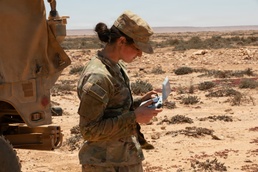
TAN-TAN, Morocco — U.S. Soldiers assigned to the 1st Battalion, 503rd Infantry Regiment, 173rd Mobile Brigade Combat Team (Airborne), conducted autonomous tactical vehicle training during African Lion 26 at Cap Draa, Tan-Tan, Morocco, April 30, 2026.
The training gave service members an opportunity to test artificial intelligence-powered and autonomous platforms across attack, defense and mission command operations.
“This training allows us to experiment with technologies that can reduce risk to Soldiers while increasing our operational reach,” said U.S. Army 1st Lt. Ethan Burdette, officer in charge of the training and assigned to the 173rd MBCT. “We’re learning how to integrate autonomous systems into real-world scenarios, not just theory.”
The exercise focused on accelerating the sensor-to-shooter kill chain, compressing decision timelines and delivering scalable, cost-effective warfighting solutions aligned with regional security needs.
“Speed and precision are everything on the modern battlefield,” Burdette said. “These systems help us make faster, more informed decisions and share that information across formations and with our partners.”
AL26, U.S. Africa Command’s largest annual joint exercise, designed to strengthen collective security capabilities of the U.S., Africannationsand global allies and led by U.S. Army Southern European Task Force, Africa (SETAF-AF).
“I think it’s important for multinational militaries to train together and learn from our partners and allies, that way we can all become better in our prospective areas,” said U.S. Army Pfc. David Pomeroy, a combat engineer assigned to the 173rd MBCT. “The way wars are fought are evolving everyday and we must learn new strategies in order for us to never fall behind.”
Running from April 20 to May 8, the multinational training spans Ghana, Morocco, Senegal and Tunisia including more than 5,600 civilian and military personnel from over 40 nations, reinforcing interoperability and strengthening collective security capabilities among U.S., African and allied forces.
“Working alongside our partners ensures these technologies are adaptable and relevant to shared challenges,” Burdette said. “It’s about building solutions together that enhance regional stability.”