CAMP WILLIAMS, Utah – The Utah National Guard conducted Exercise Wolverine, a joint training event held April 27–30, 2026, focused on improving coordination capabilities across cyber operations, joint fires, and support to civil authorities in a contested homeland environment. The exercise emphasized building trust and strengthening partnerships between military and civilian organizations.
The name “Wolverine” comes directly from the 1984 film Red Dawn, which follows a foreign invasion of the U.S. and the fight to defend communities on domestic soil. Exercise Wolverine builds on that concept, simulating what happens when an adversary targets the U.S. homeland.
The exercise focused on responding to potential threats at home, testing coordination, communication, and the ability to operate in a stressed domestic environment.
Exercise Wolverine culminated on April 30 with combined operations in Utah, including Camp W.G Williams, South Towne Mall in Sandy, Dugway Proving Grounds, Utah Test and Training Range, and the Don A. Christiansen Water Treatment Plant in Orem. The training brought together 20 Utah National Guard units from both Army and Air components, including elements of the 204th Maneuver Enhancement Brigade (MEB), 65th Field Artillery Brigade (FAB), 97th Aviation Troop Command (AVTC), 8th Homeland Response Force (HRF), and Detachment 3, Cyber Protection Team (CPT) 174, along with Air National Guard units from the 151st Wing, the 75th Medical Group from Hill Air Force Base, and additional supporting units.
The exercise also integrated state and civilian partners, including the Utah State Emergency Operations Center, Utah Department of Health, Utah Valley University, the Statewide Information and Analysis Center, and industry partners supporting cyber and communications capabilities.
“This is the first exercise we’ve conducted where the entire concept is based on a contested homeland,” said Maj. Gen. Daniel D. Boyack, adjutant general of the Utah National Guard. “For years, we believed the homeland was a sanctuary. That assumption is changing, and Exercise Wolverine allows us to explore what defending the homeland truly looks like.”
The exercise was the result of a six-month planning cycle led by Joint Force Headquarters personnel, who supported mission planning, threat development and operational execution. In the months leading up to Exercise Wolverine, planners worked through 12 training scenarios to help build and update operational plans focused on homeland defense.
During the exercise, the JFHQ team operated from the Joint Operations Center in Draper for five days, coordinating across directorates and refining response processes. The effort also produced physical planning binders for each directorate, giving leaders ready-to-use references designed to improve training, coordination and response time during future events.
The exercise began with a simulated cyber incident affecting critical infrastructure, disrupting power and communication across Salt Lake and Utah counties.
“The fight in cyberspace is right here in our local communities,” said Capt. Tyler Jacox, commander of Detachment 3, CPT 174th.
“It’s in our hospitals, schools, power systems, and water systems – everyday services we rely on. That critical infrastructure makes up the modern battlefield. If we wait until something happens, we’ve already lost.” The scenario escalated with an artificial attack on the Don A. Christiansen Water Treatment Plant, which serves over 2.5 million people along the Wasatch Front, challenging military and civilian partners to maintain essential services and restore operations. To expedite response, UH-60 Black Hawk helicopters from the 97th AVTC transported Maj. Gen. Boyack and other key UTNG and civilian personnel to the facility to assess simulated cyber damage and coordinate response efforts.
“We want to identify weaknesses and blind spots, ensure our systems are effective, and build confidence that we can respond to a real cybersecurity attack,” said Brett Taylor, lead treatment operator for the facility.
Master Sgt. Jesse Marrott, domestic operations chief for Joint Force Headquarters for the Utah Air National Guard, served as the liaison between state agencies and Guard cyber teams throughout the exercise.
“The key message is to train early and build relationships before an emergency happens,” Marrott said. “Take time now to exchange information, understand how each organization operates, and build trust. That preparation is what will make coordination effective when a real incident occurs.”
Marrott said exercises like Wolverine help identify strengths, shortfalls, and opportunities to improve response efforts.
“These exercises help us combine skills, tools, and capabilities to improve overall emergency response for the state of Utah,” said Marrott.
For Master Sgt. Nathan Torres, the chemical, biological, radiological, and nuclear (CBRN) Task Force noncommissioned officer in charge assigned to the HRF, the homeland mission is deeply personal.
“I think the public should understand that we’re doing this as an exercise to protect our families,” Torres said. “This is for our families, so people in the community know we’re preparing for an incident and that we’re here to help.” The HRF supports regional response across six states to catastrophic CBRN incidents, with units trained and ready to deploy across the United States. Torres said training alongside civilian agencies and other UTNG members is critical because those relationships directly impact response efforts.
“This type of exercise brings us together so we can understand our capabilities and how we’ll work with each other when an event happens,” Torres said.
Training took place across multiple locations on Camp Williams, including the Medical Simulation Training Center (MSTC). The facility uses realistic patient simulators to replicate medical emergencies. There, military and civilian personnel trained side by side in trauma care, building confidence in their clinical skills under simulated real-world pressure.
“The realism of this environment makes a difference,” said Maj. Ryan Robison, medical plans officer for the 151st Medical Detachment 1. “It gives people a better idea of what they’ll face before they’re actually in that situation, so they’re not going in blind.”
The MSTC uses life-like mannequins that simulate realistic injuries, vital signs, and patient responses to emergencies. The added realism creates a high-stress environment, challenging service members and community partners to not only think critically, but also communicate effectively while performing under pressure.
“The mannequins don’t just sit there, you actually have to treat them,” said Master Sgt. Holly McLelland, operations noncommissioned officer and medic for the 151st Medical Group. “If you don’t apply a tourniquet correctly, it won’t work.”
The exercise also highlighted the capabilities of Camp Williams’ western training area, which supports a wide range of operations, including live-fire artillery training, weapons qualifications, explosive ordnance disposal training, and squad maneuvering in both rural and urban environments.
Soldiers from the 204th MEB set up a tactical operations center (TOC) in the field, operating under concealment to reduce their visibility to unmanned aircraft systems (UAS). Using camouflage netting, terrain, and secure communication practices, they worked to stay off the radar, highlighting the growing threat that drones pose to command posts. The TOC served as a central hub for tracking personnel and managing airspace, helping ensure drones, helicopters, and other aircraft operated safely while keeping a low-profile.
Command Post personnel also helped coordinate key actions throughout the exercise, supporting situational awareness and response processes tied to mission execution and recall activity. Their work included communication in and communication out, helping ensure information moved quickly, actions were tracked, and decisions were supported across the force as events developed.
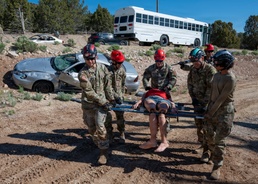
During the event, aviation assets from the 97th AVTC transported over 40 Soldiers from the 65th FAB from Camp Williams to the western training area, where they immediately began squad maneuvering techniques and conducting casualty extraction in response to a simulated CBRN attack.
A key feature of the training area, known as the “rubble pile,” simulated a mass casualty scenario involving a train derailment. Search and extraction teams and hazmat specialists worked alongside medics from the 151st Medical Group through a series of deliberate steps, beginning with reconnaissance to locate victims, followed by shoring to stabilize damaged structures, breaching to create access points, and lift and haul techniques to remove debris.
“We start with recon to locate victims, then move into shoring, breaching, and lifting operations to safely reach them,” said Sgt. 1st Class Nathan Olsen, noncommissioned officer in charge of the search and extraction team with the HRF. “Each step builds on the last to make sure we can get in and out safely.”
The process requires precision and patience, as teams must ensure structures are stable before attempting to reach survivors.
“We don’t go into a structure unless we know it’s stable,” said Sgt. Trevor Mohler, a squad leader with the search and extraction team. “Our job is to shore it up first so it can support itself, then we can go in and get people out safely.” The training reflects the urgency and complexity of real-world response operations, where service members must be ready to act quickly.
“In a real-world scenario, our citizen-Soldiers would be asked on a moment’s notice to leave their jobs and families to respond,” said Lt. Col. Rob Dent, deputy commander of the HRF. “That’s the reality we’re preparing for.” The exercise also included support from Utah Task Force 1, a FEMA urban search and rescue team, which worked alongside UTNG personnel during search and extraction operations.
“These are very perishable skills; if you’re not training on them constantly, they’re easily forgotten,” said Patrick Wells, a Utah Task Force 1 rescue specialist. “Training together helps us understand how each other operates so we can respond more effectively when it matters most.”
Throughout Exercise Wolverine, units executed key events including joint fires coordination, medical evacuation and response, cyber defense of critical infrastructure, civil support operations, and counter-unmanned aircraft system operations. These events also validated advanced capabilities, including coordination between artillery, aviation, and UAS, and multi-domain command and control.
Flying operations added another layer of complexity to the exercise, with 18 aircraft flown, including KC-135 Stratotankers, F-35 Lightning IIs, F-15E Strike Eagles, AH-64 Apaches, F-5s and C-172s. During the scenario, the KC-135 supported F-35 operations by providing aerial refueling while also using onboard air battle managers to provide an enhanced tactical picture through Advanced Real-Time Cockpit, or ARTC, capabilities.
The exercise also demonstrated agile combat employment in an austere environment through hot-pit refueling, minor aircraft maintenance and aircraft bed-down procedures. To add realism to the air defense portion of the exercise, three Civil Air Patrol C-172 aircraft represented simulated drone attacks, forcing participants to respond to a more complex and dynamic operating environment.
Among those capabilities, Link-16 played a critical role in supporting communication and coordination across participating units. The tactical data network allows information sharing across air and ground platforms, even in compromised environments.
Chief Warrant Officer 3 Nicholas Pantuso, command and control systems integrator with Headquarters and Headquarters Battalion, 65th FAB, said the system helps connect Army and Air National Guard assets to improve mission management and emergency response during large-scale incidents.
“This network allows us to leverage everything the Air National Guard has, everything Army aviation has, and create a command-and-control operations center on the ground to facilitate all of the emergency response we need here at home,” Pantuso said.
Pantuso said that while Link-16 is usually used for aircraft communication and air defense operations, Exercise Wolverine provided a unique opportunity by repurposing the system to enhance Utah’s disaster response. Exercise Wolverine also highlighted evolving capabilities across the force, including counter UAS operations. Soldiers from the 65th FAB used Q-50, a specialized radar system to detect and track drone activity, adapting traditional battlefield technology to potential domestic threats.
Staff Sgt. Spencer De La Cruz, section chief with the target acquisition platoon, Headquarters and Headquarters Company, 65th FAB, said the system has expanded to adapt to modern threats.
“Our newer capability is that we can now detect unmanned aircraft systems,” said De La Cruz.
In addition to detecting drones, the radar system can identify indirect fire threats such as mortars and rockets, allowing units to quickly locate and respond to potential hazards while improving situational awareness and protection for personnel.
“We were able to give early warning from our system, and it helped save lives,” De La Cruz said.
For many Utah Soldiers and Airmen, Exercise Wolverine goes beyond the typical drill weekend, reinforcing why proficiency and unit cohesion are important when supporting homeland missions and responding to emergencies within their own communities.
Private 1st Class Emmery D’Souza, a radio communication specialist for Headquarters Support Company, 204th MEB, who has served in the UTNG for just over a year, said the training provided valuable hands-on experience while working alongside more experienced Soldiers.
“It’s been a good experience,” she said. “I like being part of a team and learning new things, as well as seeing what I can contribute.” D’Souza said her family inspires her motivation to serve.
“I have a son, and he’s very important to me,” she said. “I wanted to create a better life for him and serve something bigger than myself.”
Exercise Wolverine reflects the UTNG's focus on innovation, readiness, and culture, bringing new capabilities together, strengthening the force, and building the relationships needed to respond effectively. “Let’s figure those things out now while we’re not under duress,” Maj. Gen. Boyack said.
Supporting the homeland defense mission carries added significance for many UTNG members, who live and serve in the same communities they swore to protect. Exercise Wolverine showed that defending the homeland is an ongoing mission.
Through training together and building community support ahead of time, UTNG Soldiers and Airmen are better prepared to respond when it matters most, here at home