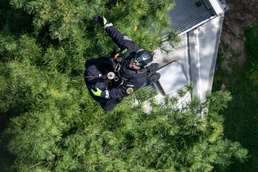
The Maryland National Guard (MDNG) supported a massive search and rescue exercise (SAREX) spanning 20 square miles of land and water, from the Loch Raven Reservoir Dam to Gunpowder Falls State Park, along with emergency responders from around the state, April 23, 2026.
The MDNG Joint Staff coordinated the response of a CH-47 Chinook, two UH-60 Black Hawks with rescue-trained civilian firefighters of the Maryland Helicopter Aquatic Response Team (MD-HART), and two Light Medium Tactical Vehicles (LMTVs) in support of civilian authorities during the exercise to enhance Maryland’s statewide preparedness, interagency coordination, and operational capabilities.
“This is a great opportunity for us to integrate with the state and local partners to show our capabilities and ensure that everybody understands our capabilities and what we bring to the fight for Marylanders,” said Maryland Army National Guard Louis Patrick Hawkins Jr., chief of staff for the Maryland National Guard Joint Staff. “This training matters because we don’t get a second chance during an emergency. Whether that’s saving somebody’s life or transportation to a medical facility, you don’t get a second chance to do that correctly.”
State agencies, local jurisdictions, and non-governmental organizations gathered in Baltimore County to test their skills through a series of immersive scenarios during the 12-hour operational period. The exercise scenario tested the emergency response if the Loch Raven Dam Reservoir broke and floodwaters along the Gunpowder Falls to the Chesapeake Bay washed out roads, homes, and businesses.
“First and foremost, it’s about partnerships and relationships,” said Kiona Black, exercise director and response coordination manager, Maryland Department of Emergency Management. “Meeting somebody the first time on the worst day ever is never a great idea. We have a lot of talent in Maryland when it comes to special operations, but they don’t all get to play together all the time. We’re mainly siloed within our jurisdictions, running the everyday calls, but we have seen more and more challenges over the past couple of years in Maryland, like the Key Bridge incident, the aviation collision [in the Potomac River], the Western Maryland flooding, and even back to 2018, [with the floods in] Ellicott City too. So we need to build trust in those relationships ahead of time, and that is exactly what this training exercise is about. That’s why the SAREX is so important.”
The exercise incorporated high-fidelity props to evaluate responders’ technical skills, while a combination of mannequins and live role players introduced a vital human dimension to the triage process. Maryland Air National Guard members of the student flight served as 20 of the role players prepositioned on vehicles and “buildings” placed in and around the water for rescuers to hoist back to safety during the scenarios.
“It was an opportunity to contribute to the readiness of the state’s emergency responders and to see firsthand the impact of their future service,” said Maryland Air National Guard Senior Master Sgt. Robert Pounders, 175th Force Support Squadron force development office superintendent. “Their involvement not only made the exercise more realistic for the other participants but also provided them with a memorable and educational experience that will undoubtedly serve them well as they begin their military careers. The 175th Wing is proud of its Student Flight members for their professionalism and dedication during this important state exercise.”
The complex incidents of the SAREX showcased a coordinated and effective emergency response system of the various Maryland agencies to come together to support their communities.
“I’ve been a part of many real-world responses, and any time you have these incidents, they’re naturally chaotic,” said Maryland Army National Guard Maj. Seth Clute, commander of the 1st Battalion, 224th Aviation Regiment (Security & Support). “The advantage of conducting these exercises is that it allows us to practice in realistic scenarios, which allow us to truly experience the chaos and still execute operations. So when it comes to staying calm in those real-world situations, practice helps, and we have a background of training to fall back on.”
Clute and other aviators from the Maryland State Police, the Baltimore County Police Department, and the Department of Natural Resources Police safely deconflicted the airspace to provide a comprehensive response to the catastrophic events of the exercise and respond to all the various sites. MDARNG Black Hawk aircrew and MD-HART rescuers did basket and sling hoists from land and water.
The Chinook aircrew moved local fire department boats and other first responders, while Soldiers with high-clearance LMTVs also transported emergency personnel where other law enforcement and fire department vehicles could not go during the simulated flooding.
“Regular practice means that we can be faster, the information that comes through is clearer, and we’re able to respond quickly to any incident,” said Clute. “Conducting these exercises allows us to be always ready and always prepared to respond to any emergency within the state.”