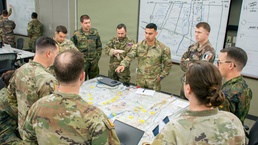
FORT LEAVENWORTH, Kansas – Gathered in small groups around acetate-covered maps littered with marker lines and circles, U.S. Army and German Bundeswehr students discussed large-scale combat operations during one of the U.S. Army Command and General Staff College’s longest running exchange exercises, Eagle Adler.
The exercise is part of CGSC’s Command and General Staff Officer Course’s elective season and is a joint exercise focused on division and corps level planning.
Eagle Adler includes more than a dozen students from CGSC’s German equivalent.
Like many exercises across the Army, Eagle Adler creates opportunities for Soldiers to develop critical warfighter skills.
For students at CGSOC, those include ability to think and fight in a joint environment with any ally or planning process, Rob Smith, assistant professor in CGSC’s Department of Army Tactics and exercise lead explained.
“Exercises like this strengthen critical thinking by exposing students to how different partners approach problems and apply their experience to tactical problem sets,” he said.
Eagle-Adler adds approximately 100 additional hours of planning exercise to the students’ experience.
The two-part exercise includes planning using NATO APP-28 and the Military Decision-Making Process.
The most recent iteration incorporated the use of artificial intelligence and command operating collaboration systems for planning product production.
Eagle Adler impacts U.S. and German students beyond building warfighter skills for large-scale combat operations in a complex, contemporary environment model.
Lt. Col. Marc-Andre Walther, assistant professor in CGSC’s DTAC, said planning is only a piece of the outcomes for the officers, citing the professional network building and understanding of current challenges of war.
“Professional military education aims to expand the knowledge and understanding of the operational environment of the students to enable them to plan and execute operations in complex and chaotic circumstances,” he said. “To quote [Carl Von] Clausewitz: ‘Knowledge must become capability’. The exchange directly contributes to that.”
Similar sentiment was shared by Lt. Col. Michael Utsch, German Army student.
Learning MDMP and sharing expertise of NATO planning processes, is only part of the lessons, he explained, building interoperability through trust and mutual understanding are secondary take aways.
“In a security environment that is becoming increasingly complex and unpredictable, it is clear that we have to face future challenges together. Our strength lies in standing together as allies, united by shared values, mutual trust and a common commitment to peace and security,” Utsch said. “Experiences like this exchange remind us that cooperation is not just a principle, but a necessity. The relationship we build here today will be essential for the missions we may face together tomorrow.”
Eagle Adler is a close replica of a joint planning environment. Students like Utsch and Maj. Mark Marten, U.S. Army logistician, will likely find themselves in upon graduation, making the “reps and sets” from the exercise critical to warfighter capability.
“We've got the time and space to really sit down and plan through some complex problems and issues that we would face when we work together downrange,” Marten said. “This is probably the best time and only opportunity we have to calmly plan through very complex problems.”
Lasting just over a week, Utsch described how professional trust was evident quickly, allowing students to focus less on getting to know each other, and learn about each other’s military abilities.
This trust and a whiteboard allowed Utsch and Marten to identify similarities in planning and logistics, generating lasting interoperability, Utsch explained.
“Even though the German students have very similar life experience, as well as training and planning considerations, they approach certain things like risk and how they mitigate and plan through uncertainty in a different way than American students do,” Marten explained. “Having an opportunity to understand what they could be thinking, or how they would approach a certain problem provides us insight as well as clear, concise language to get through some of the interplay of confusion when it comes to translation.”
According to Walther and Smith, the longevity of the exercise is a continued collective commitment to education of military leaders and allied national security objectives.
Next academic year, Eagle Adler will celebrate it’s 60th year of the joint planning exercise.