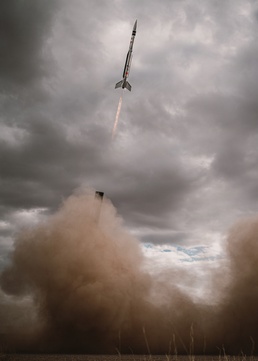
REDSTONE ARSENAL, Ala. – No matter the conditions, one team supports fellow Department of War testing The Targets Team of the U.S. Army Space and Missile Defense Command Technical Center’s Test Directorate recently conducted a series of tests during the first two flights of Ursa Major’s Draper liquid rocket engine in support of the U.S. Air Force Research Lab.
The first flight, Advanced Rapid Missile Demo, or ARMD-1, was conducted on March 6 and the second flight, ARMD-2, occurred April 20.
“For this test, we provided range coordination and ground support for the Air Force Research Lab in the development of a new liquid rocket engine,” said Meeda Bosse, test director of the two missions. “I only have experience with solid motors, so this test was a big change. Our team had to overcome challenges around storing and moving the fuel and oxidizer. This provided new challenges as the process and procedures we usually rely on were not yet in place for this new development. I look forward to seeing the continued development of this engine.
“It was exciting to work with the customer and their team to develop the necessary procedures to meet safety requirements and perform a successful flight test,” she added. “In addition, the ground crew were incredibly resilient in providing support in a constantly evolving environment. They were able to overcome every challenge and provide excellent support to our customer. It was very exciting to be involved in a developmental program this early on.”
Another team member said the technology validated in this test will provide missile defense customers much more flexibility in flight trajectory and mission planning.
“The launch was very exciting, as it was a change in pace from our typical flight test targets,” said Olivia Miller, mission alternate test director. “This was our first launch of a liquid engine as opposed to a solid rocket motor, so that required a completely new concept of operations. I learned a lot about the logistics of safely handling and fueling liquid propellant, as well as the technology behind liquid rocket engines.”
Miller said the team was extremely focused from the beginning of site buildup to vehicle lift-off, which spanned multiple months.
“There were a lot of firsts on this program, so the team was in constant communication to ensure all safety requirements were met and all necessary ground support equipment and personnel were available for a successful test,” Miller said. “When issues arose, the team coordinated with the necessary personnel to get the issues resolved efficiently, leading to two successful ARMD launches.”
Cain Crouch, chief of the Targets and Test Resources Branch, said team members literally built a launch site using our mobile assets out of a dirt pad and were challenged with helping their Air Force Research Lab customer launch their first two missiles on White Sands Missile Range, New Mexico.
“It’s always exciting to see new technology demonstrated for the first time, but it comes with many new challenges,” Crouch said. “In addition to new technology challenges, we launched these missiles from an extremely remote location on WSMR.
“Our team are absolute professionals, and did everything possible to make this happen for our customers,” he added. “They remained deployed for weeks on end and spent many dusty, windy, and cold days in the middle of the desert this winter. In the end, we were successful because of the tireless efforts of those three individuals. I’m extremely proud of their dedication and perseverance.”