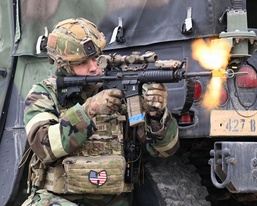
YOUNGSTOWN, N.Y.– One hundred Airmen assigned to the New York Air National Guard’s 107th Attack Wing completedNiagara Warrior2026, a large-scale readiness exercise held April 10–12 at the Youngstown Local Training Area.
The exercise marked the first timeNiagara Warriorwas conducted off base and incorporated support from a sister service.
In previous years,Niagara Warriorwas held atNiagaraFalls Air Reserve Station and included an airlift aroundNiagaraFalls to simulate relocating to a new operating location under degraded conditions.
This year, two CH-47 Chinook helicopters assigned to the New York Army National Guard’s 3rd Battalion, 126th Aviation Regiment, based in Rochester, transported Airmen to the Youngstown Local Training Area, a New York National Guard training site in Youngstown.
“Moving Niagara Warrior off base and adding Army aviation support gave our Airmen a more realistic look at what it takes to operate away from home station,” said Lt Col Damon Antonetti, Chief of Wing Plans and Exercise Director.
For many Airmen, the flight was their first time aboard a CH-47.
Airman 1st Class Randi Fuller, a West Seneca resident and first-timeNiagara Warriorparticipant, said the helicopter ride was one of the early highlights of the exercise.
“I was really excited and anticipating motion sickness, but it never came,” Fuller said.
Niagara Warrioris designed to test the wing’s ability to operate in a contested or degraded environment while sustaining mission-essential functions away from home station.
The 2026 exercise demonstrated the wing’s ability to deploy personnel, establish field operations, respond to simulated threats and work alongside Army Guard aviation assets in support of readiness training.
Over the course of the three-day exercise, Airmen responded to complex assaults, simulated chemical attacks, communications outages and other challenges associated with operating from a field environment.
The play area also saw significant rain leading up to and during the exercise, further complicating both players and organizers plans and deployment.
“Austere conditions just add another level of realism our players could see down range,” Antonetti said. Despite the rain and mud, Antonetti commended the players flexibility in the face of challenging, unpredictable weather. “Overall, I thought it was a good exercise,” Fuller said. “Once we got the all-clear to set up, the team worked quickly and efficiently to get people fed. We also learned we need to check the E-SPEK more frequently to make sure everything is in order before needing to use it.”
The exercise also gave experienced Airmen an opportunity to guide junior personnel and identify areas for improvement.
Fuller served as the 107th Attack Wing’s Military and Readiness Program Manager, and as an assistant food manager and Expandable Single Pallet Expeditionary Kitchen, or E-SPEK, specialist during the exercise.
For Staff Sgt. Austin Childs, aNiagaraFalls resident who served as the radio frequency transmissions specialist for the exercise, communications planning was one of the defining challenges.
Childs said issuing equipment and adhering to call signs went well, but minor planning issues early in the exercise created larger challenges later.
“The communications squadron ultimately did very well, but minor, early planning oversights showed some areas to keep in mind moving forward,” Childs said.
For Tech. Sgt. Andrew Mach, a North Tonawanda resident who served as the Security Forces flight chief for the exercise, communications affected a different part of the mission.
Mach was responsible for overseeing security forces personnel, coordinating operations and advising defenders on weapons employment, tactics and safety.
During the exercise, defenders responded to base defense operations, force protection condition changes and simulated threats that required quick decision-making and coordination across teams.
Early in the exercise, Mach said coordination gaps affected defenders’ response time.
“It immediately reinforced the need for clearer command and control and more emphasis on rehearsing for contingencies,” Mach said.
By the final exercise inject of the third day, Mach said he saw improvement in the unit’s ability to adapt to changing conditions, maintain accountability and operate safely and effectively.
“Leadership, communication, and teamwork were strong,” Mach said. “The exercise provided realistic, valuable training that strengthened readiness and highlighted our improvement areas.”