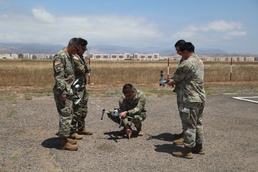
AGADIR, Morocco — U.S. service members focused on advancing innovation to maintain battlefield superiority amid rapidly evolving threats and emerging technologies during African Lion 26.
As the largest multinational exercise in Africa, AL26 provided a multidomain training and experimentation environment where joint and combined forces integrated emerging technologies into real-world scenarios. The exercise emphasized interoperability, experimentation and readiness while aligning capabilities with African partner regional security priorities.
Exercise participants evaluated artificial intelligence-enabled and autonomous platforms, remote systems and other emerging technologies across attack, defense and mission command operations, contributing to cost-effective and adaptable warfighting solutions.
“Central to this effort is the evolution of the ‘Bumblebee’ counter-unmanned aerial system,” said U.S. Army Sgt. 1st Class Derrick Guyton, an instructor with 7th Army Training Command who teaches small unmanned aerial systems. “The Bumblebee was designed as a compact, agile interceptor capable of neutralizing small unmanned aerial threats with an emphasis on portability and rapid deployment. This training and the operational feedback will improve current counter-UAS capabilities and inform future technological developments.”
AL26’s plan involved integrating emerging technology with structured, progressive training. U.S. Soldiers executed a deliberate progression from classroom instruction to hands-on application and mission-focused employment.
“We conducted a three-day training progression that included classroom instruction, hands-on training and a culminating exercise,” Guyton said. “The goal is to see U.S. Soldiers employ the system in a mission set, operate it effectively and recover equipment.”
He emphasized the platform’s versatility across multiple mission sets.
“It is a first-person-view capable system that can conduct intelligence, surveillance and reconnaissance, strike and payload delivery,” Guyton said. “Operators can control multiple platforms from a single ground control station and execute simultaneous tasks.”
Guyton noted the system’s role in future operations.
“This capability extends the fight beyond forward lines, allowing forces to reach deeper into the battlefield while enabling maneuver elements to advance,” he said. “African Lion also strengthens partnerships and demonstrates our ability to train alongside allies in complex environments.”
For U.S. Soldiers training with the system, the experience directly contributed to readiness.
“This is our first time training with this capability as a unit,” said U.S. Army Sgt. Pedro Gallardo, a combat medic assigned to the 7th Engineer Brigade, 21st Theater Sustainment Command. “It improves our ability to support mobility and counter-mobility operations while adapting to new technology.”
Joint Interagency Task Force 401 continues to drive the development and integration of counter-UAS capabilities supporting similar efforts. The organization emphasizes a layered defense approach, combining multiple systems and capabilities rather than relying on a single solution.
JIATF-401 is investing in training environments to ensure warfighters can effectively employ emerging technologies, using kinetic defeat options alongside enhanced air domain awareness through interoperable systems.
“Drones are the defining threat of our time,” said U.S. Army Brig. Gen. Matt Ross, director of JIATF-401. “The proliferation of inexpensive unmanned aerial systems allows nonstate actors and individuals to access intelligence, surveillance, reconnaissance and precision strike tools in ways that were previously only available to state actors. This presents a direct and growing threat to our installations, our personnel, our mission, and our partners and allies. We must be proactive with creating a layered defense that includes kinetic defeat options at all of our facilities at home and abroad.”
The evaluation of systems like the Bumblebee during AL26 demonstrated how the U.S. Army is aligning innovation with training to enhance operational readiness. By leveraging multinational exercises as real-world experimentation platforms, U.S. forces validate emerging capabilities while strengthening partnerships and preparing for future threats.