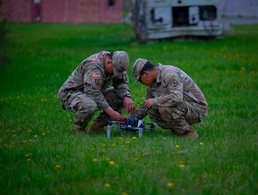
FORT DRUM, New York - Soldiers assigned to the 10th Mountain Division began training with the Bumblebee V1 counter-drone system, introducing a capability aimed at improving the warfighter’s ability to detect and defeat the threat of unmanned aerial systems (UAS) on the modern battlefield.
The training, held on Fort Drum, brought together Soldiers from different units to train on and operate the new system, which is expected to become the Army's standard for future warfighting. Joint Interagency Task Force 401 (JIATF-401), the premier Department of War counter drone organization, partnered with the 10th Mountain Division to operationally assess low-cost, attritable air-to-air interceptors.
JIATF-401 invests in training to ensure warfighters can effectively employ emerging technologies, integrating kinetic defeat options to establish a layered defense against UAS threats at home and on the battlefield.
"Countering drones is both a battlefield and a homeland defense imperative,” said U.S. Army Brig. Gen. Matt Ross, director of JIATF-401. “Training opportunities like this one at 10th Mountain Division enable us to increase counter drone capabilities across the entire joint force to keep pace with this threat."
The Bumblebee is a first-person-view, multirotor drone designed specifically for counter-unmanned aerial system missions. Incorporating automated target recognition, the system is capable of identifying and tracking hostile drones with limited operator input. This allows Soldiers to focus on maneuvering, communication and battlefield awareness while the system executes intercept functions.
“It came to us in a counter unmanned aerial systems capacity, but we’re finding that it’s more of a multi-role fighter. It can do everything from short-range reconnaissance, to detecting threats on the battlefield, on the ground, in the air," said Lt. Col. Max Ferguson, the director of operations for 10th Mountain Division. “It has the ability to do launched effects, it's classified as a munition, and we can use it as a one way attack, or we can use it to drop ordinance.”
The introduction of the Bumblebee V1 reflects lessons learned from recent conflicts, where unmanned systems have become a persistent threat. By incorporating these capabilities into training at Fort Drum, the 10th Mountain Division is working to ensure Soldiers are prepared to operate in increasingly contested and technologically complex environments.
“It gets a lot of guys out of the line of fire, so you're not running into bunkers and fortified positions anymore which makes me feel better, makes everyone feel better,” said Spc. Cevyn Jay Paydy, an infantryman assigned to 4th Battalion, 31st Infantry Regiment, 2nd Brigade Combat Team, 10th Mountain Division. "It is way safer and more viable to hit with drones and other capabilities before going into anything, so I think it totally enhances our ability to do just about any mission.”
This is the blueprint for how Soldiers at the lowest level will have access to real-time aerial reconnaissance that was once reserved for higher headquarters. Squad and platoon leaders can quickly launch drones to scout terrain, identify enemy positions and adjust movements without waiting for external support. This immediacy compresses decision-making timelines and increases the speed at which engagements unfold.
“It’s a really capable component of a wider system, we have to learn how to integrate it with detection, and integrate those sensors with our maneuver,” said Ferguson. “This is the beginning of a shift in how we think about a three dimensional fight where drones are common on the battlefield.”
As the Army continues to modernize, training events like this highlight the growing role of unmanned and counter-unmanned systems in small-unit operations. For the 10th Mountain Division, the integration of the Bumblebee V1 marks a step toward maintaining an advantage against evolving threats.
“If we are able to eliminate the enemies before friendly forces get there, that's a win for us. We're able to eliminate them without putting friendly lives in danger,” said Spc. Quentin Martinez, a master trainer assigned to the Multi-Functional Reconnaissance Company, 1st Brigade Combat Team, 10th Mountain Division.