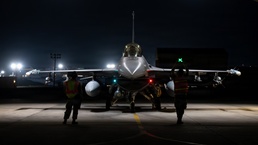
KADENA AIR BASE, Japan– Deployed members of the Colorado Air National Guard conducted joint-force operations alongside sister branches of the U.S. military and allied forces in the Indo-Pacific region in February 2026.
Operating in a theater defined by strategic competition, these missions are critical to projecting credible combat power, strengthening interoperability, and reinforcing the U.S. commitment to maintaining a free and open Indo-Pacific region.
“It’s hard for me to pinpoint a single superhero when I feel like everyone has stepped up in that capacity,” said U.S. Air Force Master Sgt. Kelsey Loy, a first sergeant assigned to the 140th Maintenance Squadron, 140th Wing. “I think our individuals here, particularly some of our first-time deployers, have shown a tremendous amount of grit and willingness to double down as a unit and persevere.”
The 140th Airmen participated in critical training exercises pushing them to simulate wartime environments, focusing on mass airlift operations, chemical warfare survival, and the consistent, rapid generation of F-16 Fighting Falcon aircraft into the Indo-Pacific airspace.
This ability to continuously project airpower under pressure is the cornerstone of regional deterrence.
Despite logistical challenges and the different environment of the Indo-Pacific theater, COANG members have adapted, accomplishing their mission with persistence and innovation. The training completed prior to deployment prepared them to identify obstacles early and remain focused on their core objective: sustaining a deterrent posture.
“Our Advance Echelon team came out to Kadena ahead of everyone else,” said U.S. Air Force Staff Sgt. Caitlin Imfeld, aerospace ground equipment journeyman,140th Maintenance Squadron. “They really kicked butt and got all of our equipment ready and were actually recognized by our unit for that accomplishment.”
Operating in the Indo-Pacific demands swift, decisive action to maintain a constant state of readiness.
“You have to move quickly,” said U.S Air Force Tech. Sgt. Emelia Smith, a munitions specialist for the F-16 aircraft, when discussing the deployed environment. “Even if it seems like a small decision or we have to change out the missiles for the entire fleet, for us to be able to respond and act quickly is really the feat.”
Environmental factors, such as local airfield conditions, require constant problem-solving to ensure aircraft remain mission-capable.
“Tires have been a big issue out here,” said U.S. Air Force Tech. Sgt. Cassidy Jones, supply lead assigned to the 140th Logistics Readiness Squadron. “We have had to change several tires a day. So, we hurry and get them turned around while still ordering parts so maintenance can go out there and do their job.”
Across the deployment, the synergy between drill-status Guardsmen and full-time personnel within the 140th Wing acted as a force multiplier. “For my team specifically, you can’t tell who is a drill-status Guardsmen and who is Active Guard and Reserve,” Jones said. “I think all the prep work we did, all the exercises before coming out here, show that it helps the drill-status Guardsmen. Now we’re putting our brains together to complete this mission effectively.”
Integration extended beyond the Air Force, reflecting the joint-force operations vital to Indo-Pacific strategy.
“We integrated with the Marines to get refueled quickly to effectively complete a second mission on top of the one we had already done,” said U.S. Air Force Capt. Alyssa “Vato” Majuta, pilot,120th Fighter Squadron. “I have never met with them before, hadn’t talked to them before—but we were still able to get it done quickly.”
Integration also occurred heavily behind the scenes.
“We brought most of our stockpile, but we are fully integrated into the 18th [Wing] Munitions,” Smith said. “Not only do we serve our jets, the F-16s, but the other jets of other units here as well.”
Personnel from aircraft munitions embedded directly with Kadena's resident units, servicing a variety of combat aircraft to keep the broader Pacific fleet armed and ready.
“The 120th Fighter Squadron proves time and time again that with 100 percent manning, they just go out and absolutely crush the generation of combat airpower involving F-16s,” said U.S. Air Force Lt. Col. James “Rags” Edwards,140th Operations Support Squadron commander and F-16C pilot, deployed with the 120th FS.