The Invisible Front: How PSYOP is Redefining Modern Conflict By Capt. Rachel Deppen
FORT POLK, La.—At the Joint Readiness Training Center (JRTC), Soldiers from the 7th Psychological Operations (PSYOP) Battalion are focused on a critical aspect of modern conflict: psychological warfare. As they integrate with the 82nd Airborne Division for a demanding training rotation, they are not only honing traditional skills but are also testing the very future of their craft. Armed with experimental AI systems, tactical drones, and modern versions of classic deception tools, these Soldiers are on the front lines of defining information dominance for the next conflict.
For PSYOP units, JRTC is the ultimate proving ground. “Coming out to a CTC (Combat Training Center) gives PSYOP a chance to actually integrate with Civil Affairs, Special Forces, Ranger Regiment, and the conventional forces as well,” explained a seasoned PSYOP Observer Controller Trainer (OCT) at JRTC. He emphasized that this is not a siloed exercise, but a complex simulation of large-scale operations where PSYOP must seamlessly weave its capabilities into the broader fight.
This integration is designed to be comprehensive, with PSYOP elements supporting commanders at every level of conflict. PSYOP personnel are typically embedded at the division and brigade levels, and others work directly with other Special Operations Forces, 7th PSYOP Battalion’s Tactical PSYOP Team (TPT), focused on the battalion level. The detachment commander explained that his team’s mission placed them directly with the infantry and artillery battalions of the 82nd. This forward positioning allowed them to provide commanders on the ground with immediate access to non-kinetic options to shape the fight.
Forging the Future: A Closer Look at PSYOP’s New Toolkit A central part of the mission at JRTC is putting new experimental equipment and procedures through its paces in a realistic combat environment. This rotation featured several key pieces of technology that demonstrated significant promise for the future of psychological operations, from AI-driven content creation to advanced battlefield deception.
Ghost in the Machine: An AI-Powered Media Generator One of the most forward-looking systems being tested is the “Ghost Machine”, a ruggedized, field-deployable AI platform. Its purpose is to give Soldiers the ability to create and disseminate messages and media on the spot, dramatically reducing the time between commander’s intent and a product’s creation.
A combat camera specialist who tested the system, highlighted its audio generation feature as particularly impressive. Soldiers can input a script, and the AI can translate it and generate an audio file of a native sounding speaker reading the message in a variety of languages. This allows a team to, for example, create a targeted loudspeaker message for a specific local population or enemy unit in their own dialect within minutes, a task that would have previously required specialized linguist support and recording equipment. The system is also capable of generating simple images, providing a rapid response capability for creating basic visual aids in the field.
Drones on the Battlefield: The Sky-Raider and the “Night Haunter” Proving to be one of the most immediately impactful tools were the tactical drones. The team utilized the Sky-Raider, a powerful quadcopter notable for its significant payload capacity. This lifting strength allows it to be a versatile delivery platform for a wide range of PSYOP products.
PSYOP Soldiers from across the regiment have demonstrated their field ingenuity by designing and 3-D printing their own custom delivery mechanisms. One of the most effective pairings was using the Sky-Raider to deploy “Night Haunters.” These are small, powerful speakers housed inside a cone to better project sounds, which can be dropped into strategic locations to broadcast messages, sounds, or recordings of military equipment like tanks or munitions.
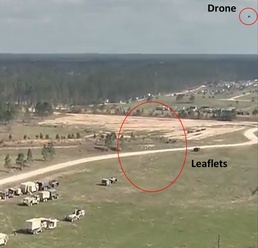
A PSYOP Soldier described the drone’s varied applications, which went far beyond simple leaflet drops. In one scenario, the team used a drone broadcasting specific sounds to subtly influence an enemy patrol’s route, channeling them directly into a pre-planned ambush by friendly infantry. In another, they used it to divert enemy armored vehicles by flying over a road and broadcasting the sounds of mining activity, deceiving the enemy into believing the route was impassable.
Tactical Deception: The “Magpie” and Dummy Artillery PSYOP teams are also modernizing classic deception tactics with new technology. By combining visual decoys with electronic warfare, they can create convincing illusions to mislead the enemy. During the rotation, the team deployed inflatable, dummy M777 howitzer barrels to create the visual signature of an artillery position. To make the deception truly believable, they paired the visual dummies with the Magpie emitter. This device is an electronic warfare tool designed to replicate the specific radio frequency (RF) signature of a real M777 howitzer’s command and control network. When the Magpie is active, and enemy conducting signals intelligence (SIGINT) will detect what appears to be a fully operational artillery firing positions.
The goal, as a detachment commander explained, is to "bait the enemy into firing on the dummy position." This multi-layered deception pressures an enemy commander to waste high-value, precision-guided munitions on a fake target. More importantly, the moment the enemy fires, their position is exposed to friendly counter-battery radar and fire, allowing US forces to destroy the real enemy asset. It's a sophisticated trap that turns the enemy's own intelligence-gathering against them.
Forging a Vision for the Future The experience at JRTC is about more than just testing new equipment, it’s about shaping the future role of PSYOP. The military as whole sees a clear need for PSYOP’s unique skills in shaping the information environment, from the brigade’s rear area all the way to the front lines and beyond.
The vision for PSYOP is ambitious. The company’s operations officer described a role where his teams could so thoroughly control the flow of information that the enemy is paralyzed. In this vision of psychological warfare, PSYOP's job is to flood the enemy's intelligence apparatus with so much conflicting data that they "can't decipher what is true and what is not."
"As far as I'm concerned," the operations officer concluded, "what PSYOP does for that division commander is we tell the enemy what is true and what isn't. So that way, we have all the advantages."