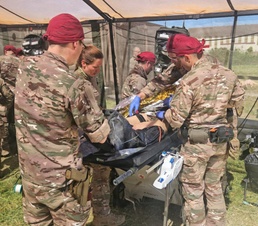
FRANCE – U.S. Army Medical Readiness Command, Europe recently deployed a team of medical personnel to central France to observe the French led Orion 26 Exercise, the largest military exercise conducted by the French military since the Cold War. More than 12,500 mostly French troops took part in the three-month drill designed to prepare for high-intensity warfare in Europe.
The Orion 26 Exercise, which ran until April 30, involved 25 ships including the aircraft carrier Charles de Gaulle, 140 aircraft, 1,200 drones and troops from 24 partner countries to include the United States, Canada, and the United Arab Emirates.
While the bulk of the Orion 26 Exercise focused on Large-Scale Combat Operations (LCSO), a significant portion of the exercise involved combat casualty care, treatment and evacuation of simulated casualties from the battlefield.
Leading the U.S. contingent of medical observers was U.S. Army Col. (Dr.) Heather O’Mara, Assistant Chief of Staff, Support Operations for Medical Readiness Command, Europe.
“Collaboration with our French military medical counterparts gave us unique insights into their approaches to combat casualty care and patient evacuation," said O’Mara. "Understanding their methodologies for triaging and moving patients from the point of injury ensures we are better prepared to save lives together in future multidomain environments."
The French Ministry of the Armed Forces described Orion 26 as "a major event in the French operational preparation for high-intensity scenarios" aimed at preparing forces for "complex situations in multiple, varied, and contested environments."
While the U.S. and French military medical personnel may wear different uniforms, use different equipment and speak different languages, they both share a common goal – providing comfort, care and compassion for the wounded, ill and injured.
According to a French military official involved in planning for the medical portion of the exercise, the objectives of the were:
- Rapid\, lifesaving medical response: Simulate scenarios with significant casualties in high-intensity\, dynamic combat zones.
- Interoperability testing: Assess the ability of French and British medical teams to operate seamlessly under joint command structures.
- Field hospital and surgical adaptation: Evaluate portable surgical units for extended operations under operational stress\, including mobility and communication constraints.
- Resilience under realistic conflict scenarios: Emphasize support in long-duration complex operations with fluctuating security contexts\, mirroring the stresses of real conflicts.
“ORION 26 provided a highly realistic, complex large-scale operations environment that effectively tested multinational military medical capabilities,” said Master Sgt. William Carlyle, Senior Operations Sergeant for Medical Readiness Command, Europe G37. “Because no single nation possesses the organic capacity to sustain prolonged LSCO medical requirements independently, seamless interoperability is an absolute operational necessity and must be a training objective in these type exercises.”
According to a senior U.S. military medical official, the French military has several highly effective aspects of combat casualty care and force integration that should be considered by allies and partners.
“It was interesting to note that the French military approach to simulated casualty generation utilizes actual front-line troops, such as infantry, rather than isolated role players or manikins,” added Carlyle. “This concept forces every warfighting function to tangibly experience the operational impact of losing personnel to casualty care, casualty evacuation, and escort duties for the wounded. Furthermore, these live role players are actively coached by observer/controllers to portray specific trauma, adding critical realism to the exercise.”
Oversight and planning of the medical portion of Orion 26 Exercise was provided by the French Defense Central Health Service. This organization is responsible for medical and sanitary support to the French Armed Forces and all institutions placed under the authority of the French Ministry of Armed Forces. It ensures adequate support for French operations in overseas theatres and provides hospital care services, administers medicals for military personnel, and gives expertise in disease prevention, and medical, dental, pharmaceutical, paramedical and veterinary research and education.