“The highly successful Rumble in the Jungle joint exercise marks a significant milestone in the State Partnership Program between the South Dakota National Guard and Suriname,” said Col. Dennis Bickett, commander of the 196th Maneuver Enhancement Brigade, South Dakota Army National Guard. “By training shoulder-to-shoulder, we deepen our mutual trust and cultural ties and enhance our tactical interoperability.”
The mission directly advanced U.S. Southern Command’s four strategic imperatives through three key lines of effort: staff-level command and control, elite jungle warfare training, and vertical engineering operations.
“In fostering and expanding these relationships, we directly support U.S. Southern Command’s broader goals of promoting regional security, countering shared threats, and fostering a stable, cooperative hemisphere,” Bickett said.
During the exercise, the Headquarters and Headquarters Company of the 153rd Engineer Battalion, SDARNG, executed a rigorous counter-narcotics military decision-making process. The staff provided command and control for 68 joint personnel, coordinating logistics directly with the U.S. Embassy and the SAF, and conducted real-world bridge and river route reconnaissance.
Lt. Col. James Forbes, commander of the 153rd Engineer Battalion, noted that the exercise was a proving ground for operating with a heavily reduced footprint, preparing forces for modern, contested environments where large command posts are easily targeted.
“For the last three years, we’ve been trying to break our battalion operations down so that we were light and we could move easily and do it anywhere in the world,” Forbes said. “Basically, I set up a problem statement: How does the 153rd conduct command and control utilizing two air pallets? This was a culmination of so many different efforts coming together.”
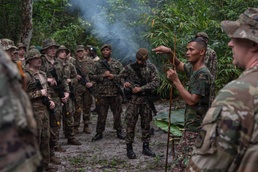
Simultaneously, 25 SDNG service members and SAF partners completed a grueling, three-phase jungle operations and survival course. To institutionalize this capability, the SDNG integrated the Army Security Cooperation Group-South to standardize joint tactics, techniques, and procedures, paving the way for the future award of U.S. Jungle Tabs and Additional Skill Identifiers.
Suriname Armed Forces 1st Sgt. Alvaro Ronoreso, the head instructor for the course, praised the U.S. forces while noting the extreme difficulty of the environment.
“They have perseverance and spirit,” Ronoreso said. “The tropical jungle is breaking their will... but we keep motivating and they keep continuing.”
Sgt. 1st Class Richard Buechler, the noncommissioned officer in charge of the U.S. jungle participants, echoed the severe physical toll of the training.
“There’s a lot of things that can slow you down and beat you up in this environment,” Buechler said. “Both Mother Nature herself and Father Time will kick you when you’re down. As long as you can keep everybody moving in the same direction, motivated, and together, you’ll be successful.”
For U.S. Embassy Paramaribo, this sustained, direct engagement serves as a vital diplomatic tool, supported by Department of War and Bureau of International Narcotics and Law Enforcement Affairs funding.
“Military-to-military cooperation, such as Operation Rumble in the Jungle, serves as a cornerstone of U.S. Embassy Paramaribo’s diplomatic toolkit,” said U.S. Navy Lt. Cmdr. Tony Leguia, senior defense official at the U.S. Embassy in Paramaribo.
Leguia emphasized that deploying U.S. forces to exchange knowledge and build institutional relationships directly counters strategic competitors like the People’s Republic of China.
“This active presence ensures the United States achieves status as Suriname’s preferred and most credible security partner,” Leguia said. “This enhanced relationship capital allows the Embassy to motivate host-nation leadership to sign bilateral agreements and pursue deeper economic engagement.”
That relationship capital was heavily reinforced in the community of Brownsweg, where 16 engineers from the 155th Engineer Company executed a high-impact Humanitarian and Civic Assistance (HCA) project. Generating over 1,600 combined man-hours alongside their SAF counterparts, the joint team renovated 14 classrooms, installed 8,200 feet of drainage, and constructed 4,000 square feet of security fencing.
Staff Sgt. Lee Gregerson, engineer project noncommissioned officer in charge with the 155th Engineer Company, SDARNG, noted his Soldiers worked 10-hour days for two weeks straight to overcome logistical hurdles and deliver the project alongside the SAF.
“Working alongside our Surinamese Armed Forces counterparts was a great experience for all our U.S. troops,” Gregerson said. “The SAF looked out for our U.S. Soldiers by helping with engagements with the local populace and local shops.”
By delivering tangible infrastructure improvements, the U.S. demonstrated a credible, positive commitment to the nation’s civilian development. The impact was highly visible during a closing ceremony attended by community elders, teachers, students, and local religious leaders.
“The community was overall supportive and happy with the end results of our project,” Gregerson added. “They were all very grateful and also spoke about wanting the U.S. Army to come back to Suriname to continue helping their community.”
Commanders assessed the operation as a total success, noting that by operating in resource-constrained environments, the SDNG tangibly increased operational readiness and solidified a critical regional partnership that remains highly beneficial to both nations.