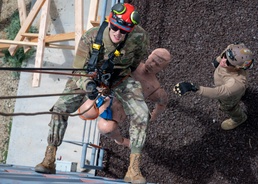
CAMP WILLIAMS, Utah - The sounds of saw blades against concrete, the striking of hammers against nails, and the movement of debris amidst collapsed rubble echoed across the western training area at Camp Williams, Utah, during a simulated search and extraction scenario conducted as part of Exercise Wolverine, April 30, 2026.
The exercise focused on strengthening joint interaction between Utah Army and Air National Guard units in disaster response and air-to-ground operations to support homeland defense in the event of a potential attack.
At the site known as the “rubble pile,” soldiers from the 1457th Engineer Battalion Search & Extraction team worked to remove simulated casualties from collapsed concrete structures in a train derailment scenario. Teams operated at a high tempo to safely remove rubble, assess casualties, and transfer simulated victims to a secure medical location. While search and extraction remained central to the scenario, additional units aided in simulated emergency response operations across the exercise.
The 65th Field Artillery Brigade (FAB) and the 204th Maneuver Enhancement Brigade (MEB) played key roles in the exercise, alongside the 151st Medical Group, the 97th Aviation Troop Command, and the 8th Homeland Response Force (HRF).
Lt. Col. Emilio Suazo, executive officer with the 65th FAB said, “We’re bringing counter-unmanned aerial systems (UAS) capabilities, communications link between the ground and Air Guard, and a fire package to the joint operations center.” He added that the training demonstrates their ability to respond to domestic emergencies while balancing both state and federal missions.
A key component of the exercise is the AN/TPQ-53 Multi-Mission Radar, operated by Soldiers from the 65th FAB. The system detects, tracks and classifies indirect fire threats, including mortars, rockets, cannons and artillery, at ranges of up to approximately 20 kilometers. In addition to its counterfire mission, the radar provides an emerging counter-unmanned aircraft system capability, enabling operators to identify and monitor UAS activity while employing survivability techniques to reduce its electromagnetic signature.
Supporting that capability, the Link 16 system enhances real-time coordination across the force. Chief Warrant Officer 3 Nicholas Pantuso, command and control systems integrator with Headquarters and Headquarters Battalion, 65th FAB described it as a multi-tactical data link that enables seamless communication between air and ground forces. The system strengthens situational awareness and supports Utah’s disaster response operations, while the exercise provides an opportunity to further integrate Link 16 into homeland defense missions.
“It’s important because we often don't get enough joint training with the Air Force and our civilian partners,” said Master Sgt. Nathan Torres, chemical, biological, radiological, and nuclear (CBRN) task force noncommissioned officer in charge with the 8th HRF.
“This is another way we can solidify that relationship and work with our partners, because when a disaster happens, we will rely on each other to accomplish these tasks.”
Exercise Wolverine enhanced the joint collaboration of military assets, personnel and expertise to provide Utah with the readiness it needs to be prepared for the threat of a potential contested homeland environment.