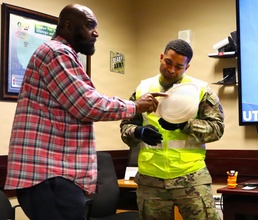
Army, Civilians Team Up for OSHA Training to Strengthen Port Ops Safety Elizabeth O. Bryson FORT EUSTIS, Va.– Soldiers and Department of the Army civilians from the 597th Transportation Brigade, ARTRANS, headquarters, bookings, planning, and operations cells recently completed Occupational Safety and Health Administration (OSHA) 10-Hour Maritime: Marine Terminals training at Fort Eustis, Virginia, led by Department of the Army civilian experts Joe Hayslett and Keddrick Best. OSHA 10-Hour training is important because it provides workers with essential knowledge to identify, avoid, and prevent workplace hazards, significantly reducing accidents and injuries.
Port and rail operations present unique and heightened hazards for Army personnel, including heavy equipment movement, complex cargo handling, and exposure to maritime environments that differ significantly from traditional field maneuvers.
The OSHA-10 Hour class is designed to help participants identify these risks, understand regulatory requirements, and apply proven strategies to mitigate hazards and keep the mission moving safely as they project the force in support of Large-Scale Combat Operations (LSCO) around the globe. The training placed special focus on port operations safety, addressing hazards such as cargo handling, machinery operation, and fall risks.
Port training is unique because of the extreme physical hazards not found in typical field maneuvers– and while OSHA generally governs port safety, the Army must train to handle uniquely military gear, such as tanks or tactical vehicles, within these strictly regulated commercial spaces. Participants learned to identify and mitigate high-risk conditions, including slips, trips, hazardous atmospheres, and equipment failures, in accordance with the Army “Safety Bible,” AR 385-10, and federal regulations outlined in Title 29 of the Code of Federal Regulations (29 CFR).
Keddrick Best, DA civilian OSHA trainer and Rapid Support operations team member, has considerable port and transportation experience; he is a retired Army first sergeant with 23 years of service, has worked as a DA civilian with ARTRANS for three years, has certifications in HVAC, Global Air Transportation Execution System (GATES), Integrated Computerized Deployment System (ICODES), OSHA 10, OSHA 30, and holds a Commercial Driver’s License (CDL).
Best said the goal of the training was to ensure everyone understands the unique safety challenges in the ARTRANS operational environment, which can include not only traditional Army hazards, such as munitions and heavy equipment, but also hazards at the port and railhead.
“By reinforcing these [OSHA] guidelines, we help prevent accidents and protect our people,” Best said. “Whether they’re working on the port, in the field or in the office. This is how we keep everybody safe and make sure we deliver on time.”
According to OSHA, the most critical takeaways for port and maritime safety focus on mitigating high-risk hazards such as falls, "struck-by" incidents, and equipment failures.
Topics discussed included:
· Fall protection: Falls remain a leading cause of fatalities. Workers must use Personal Fall Arrest Systems (PFAS) for heights and follow strict rules for walking on unguarded barge decks.
· Cargo handling: All containers and gear must be inspected for damage, such as rust or corrosion, before use. Forklifts must be correctly fitted with lift frames, and heavier containers must always be stacked on the bottom.
· Hazardous atmospheres: Employers must test for hazardous substances or low oxygen (less than 19.5%) before workers enter enclosed spaces like ship holds. Respirators must be provided if applicable.
· Vertical and horizontal hazards: Safety managers emphasize that port work involves movement above, below, and next to workers at all times, such as massive cranes lifting containers while trucks and forklifts move on the ground.
· Essential personal protective equipment (PPE): Employers are required to provide and ensure the use of specialized gear, and workers are required to wear them. This includes high-visibility vests (mandatory in traffic lanes and near container-handling equipment), flotation devices (U.S. Coast Guard-approved life jackets are required when working on unguarded decks or over water), helmets, gloves, eye protection, and protective boots (steel-toe or composite).
· Operational logistics and medical readiness: Includes traffic safety, enforcement of posted speed, and creating clear safety zones for pedestrians to prevent "struck-by" accidents with moving machinery.
· Emergency response: Medical aid should be able to reach an injured worker within five minutes, and lifesaving equipment should be readily available.
· Mandatory training: OSHA mandates that all machinery operators be fully qualified and that workers receive Hazard Communication training to handle spills or chemical leaks safely.
Joe Hayslett, who served for 20 years in the Army and has spent 14 years at Fort Eustis in Soldier and civilian capacities, has certifications in Global Air Transportation Execution System (GATES), Integrated Computerized Deployment System (ICODES), OSHA 10, OSHA 30, and holds a Commercial Driver’s License (CDL); Hayslett also has years of “stick time” as an 88 hotel, cargo specialist.
Hayslett addressed the group about the importance of risk management and having a thorough plan for dealing with hazards, including identification, mitigation, response, and evacuation if necessary.
He stressed the importance of identifying hazards early and often and applying proven safety standards to keep the mission moving forward.
“Safety is everyone’s responsibility,” Hayslett said repeatedly throughout the course.
OSHA training at ports is crucial for legal compliance, lowering insurance and operational costs, and fostering a proactive culture of safety among Army Soldiers, DA civilians, the Port Authority, and the commercial industry, otherwise known as the “fourth component.”
The importance of civilians and Soldiers taking the certification class together cannot be overlooked, as port and rail operations are areas where the team must work seamlessly together to get the job done.
Joint training between Army Soldiers and DA civilians is essential for building a cohesive “total force” capable of operating in complex port and other environments.
This integrated training fosters mutual understanding, enhances technical expertise, and ensures seamless operations between uniformed personnel and civilian professionals.
“You can’t have a world class organization without a world class safety program,” said Mark Atkins, chief of Safety and Occupational Health, U.S. Army Corps of Engineers- and the ARTRANS team is taking that to heart.
OSHA training is part of ongoing efforts to sustain mission readiness and promote the well-being of the entire workforce at the 597th Transportation Brigade and beyond– safety is everybody’s responsibility!