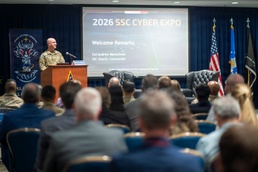
EL SEGUNDO, Calif. – The future of space superiority relies as much on networks and data as it does on assets in orbit. This was the overarching message of Space Systems Command’s (SSC) Cyber Expo keynote delivered by Charleen Laughlin, U.S. Space Force deputy chief of Space Operations for Cyber and Data.
Laughlin spoke on the first day of SSC’s 8th annual Cyber Expo held at Los Angeles Air Force Base April 21-23, 2026. More than 500 people attended the event in person and online, from industry, academia and multiple sectors of the USSF, including Combat Forces Command (CFC), U.S. Southern Command (USSOUTHCOM), Space Training and Readiness Command (STARCOM) and U.S. Space Command (USSPACECOM).
“Space operations no longer begin at launch,” Laughlin said. “They begin in software, in architectures, in data flows and in the cyber terrain that underpins every mission thread. That shift is profound and it’s reshaping what it means to generate combat power for the Space Force.”
“Every satellite, every ground system, every data node, every command-and-control function relies on cyber and data,” Laughlin said. “There is no mission thread in the Space Force that is not digitally enabled. There is no Guardian who does not rely on digital infrastructure to execute their mission.”
Traditionally, combat power was measured in missiles, aircraft and platforms, but today it’s increasingly measured in data and software, in cyber readiness and digital resilience, noted Laughlin.
“The nations that can update faster, secure faster, and decide faster will hold the advantage – not just in crisis but in every day leading up to it,” she said. "Adversaries of the United States’ understand this and are “leaning forward to shape the battle space now. They’re treating cyberspace as a continuous competition, not a domain that activates only in wartime. They’re developing offensive and dual-use capabilities designed to hold at risk the space-enabled lifelines that Americans and our allies rely on, like GPS.”
“Today’s front line is our networks and the cyber domain: this is where command and control can be disrupted, data links can be severed, and space assets can be undermined before conflict even begins,” Laughlin said. “The opening salvo of the next conflict may not be a kinetic strike – it may be a corrupted data feed, a compromised ground station or a silent failure in a system we rely on.”
In opening remarks, Col. Andrew Menschner, SSC deputy commander, encouraged attendees to “utilize this opportunity to collaborate, learn and connect.”
“Thank you for what you do every day to support our Nation, our allies and efforts to preserve peace,” Menschner said. “Together we can ensure that our Nation remains the dominant force on the final frontier.”
Menschner said when he attended the USAF Air War College, he was surprised when the agenda included a full month discussing the Peloponnesian War between Athens and Sparta, but four of those lessons are still valid to today’s challenges: rising powers nearly always come into conflict with sitting powers; rising powers rarely attack where sitting powers are strongest; the side that adapts their strategy the quickest wins; and the best way to win a conflict is to deter it from the start.
“Although our nation’s military remains the world’s greatest, it’s clear the landscape today is shifting,” Menschner said. “History teaches us the conflict is coming, and cybersecurity will play a major role in any coming conflict. The only choice for us is to be so dominant that our adversaries are deterred from making their move. At SSC, developing the capabilities to do that is a major focus.”
The expo was a two-day event in previous years but was expanded to three days this year to meet the demand for content on data and Artificial Intelligence (AI), which was the focus of the third day. Alissa Knight, founder and CEO, chief AI office of Assail, keynoted day three speaking on “Unmanned Attack Surfaces: Agentic AI and Continuous Adversarial Operations.”
On the defensive side, Knight said AI-coded applications are turning back the vulnerability clock by 20 years. AI is trained on human code and humans aren’t perfect, she explained, so when you train an AI on human-written code, it’s going to have vulnerabilities. Unfortunately, a lot of companies are using AI for coding because they want to ship code as fast as possible. As a result, Application Programming Interface (APIs) are the number one unmanned attack surface. They make up 76 percent of the traffic on the internet and are the “connective tissue” that allows different software programs to talk to each other.
“Hackers know that the data they want is in your APIs,” Knight said.
Another significant problem is that there are 4.8 million unfilled cyber positions globally, and the AI agents used by hackers don’t need to sleep. Knight said she believes human penetration testing is obsolete because AI agents can do it much faster and at a fraction of the cost of hiring a person. Autonomous AI agents can compress attack timelines from weeks to minutes.
“I believe we’ve now entered an era of machine-to-machine warfare,” Knight said. “I’m seeing the traffic; I see the packets. They are coming from AI systems, not humans.”
Other speakers during the expo included Dr. Keith Hardiman, deputy director for the Chief Information Office for the U.S. Department of the Air Force; John Weiler, CEO and CIO, IT-Acquisition Advisory Council, and Dr. Jose Angeles, USSOUTHCOM chief data officer.
On the second day, Dr. Jacob Oakley, with SIXGEN, and Michael Butler, CEO with Final Frontier Security, led a group of 20 participants through a satellite hacking workshop. Using ground station and flight simulation software, the group explored satellite system functions, exploitation techniques and vulnerabilities, including one vulnerability on the software they were using that really existed, but has since been patched.
Butler said one of the attacks the group would examine is the “Man in the Middle” where the adversary is able to insert themselves in the network path between the ground station sending the satellite commands and the parts on the satellite receiving them. Could the hackers manipulate the commands before they reached the satellite, and could they manipulate the telemetry before it reached the ground station’s processors?
“The big takeaway is not just to hack them, but also to understand that securing them is going to require cyber security professionals who have learned about space systems, or space system professionals who have learned more about cyber security,” Oakley said.
Panel discussions during the three-day expo covered such topics as how to advance the cyber workforce with mission-ready talent; digital engineering; mission application of Continuum and Quantum computing leveraging cyber ranges; Zero Trust; on-orbit cyber defense; program protection and supply chain risk management; agentic artificial intelligence and human-machine teaming. A “Lunch and Learn AI” workshop was featured on the third day of the event.
In between presentations, participants could visit 50 booths manned by industry partner and U.S. Department of War organizations for information and partnership opportunities. A “Blooming Space Van” parked nearby offered restorative wellness experiences, including breathwork and aromatherapy.
Participants also could visit a Cyber & AI Technologies Show and Tell room, which included tables manned by Pacific Northwest National Laboratory, the MITRE Corporation and CHIRP (Cyber Halo Innovation Research Program) interns. The CHIRP program is a collaboration between SSC and universities and industry partners to provide college and university students with a direct pathway into a cybersecurity career.
Through presentations, panel discussions and interactive events, Ms. Laughlin’s keynote words on day one were in evidence throughout the three-day Cyber Expo.
“Space operations no longer begin at launch,” she said. “They begin in software, in architectures, in data flows and in the cyber terrain that underpins every mission thread. That shift is profound and it’s reshaping what it means to generate combat power for the Space Force.”