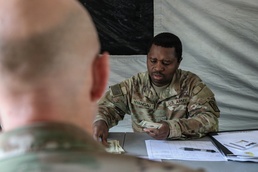
FORT BRAGG, N.C.— U.S. Soldiers from the 18th Corps Finance Battalion, 3rd Corps Sustainment Command, conducted a culminating training exercise April 27 to May 1, 2026, designed to stress the Army’s financial infrastructure under the weight of large-scale combat operations.
The exercise served as a critical proof of concept for the 18th C-FIBN as it simulated "theater opening operations." By establishing banking links and financial architecture in an immature environment, they demonstrated that purchasing power can move just as fast as the maneuver force.
The financial kill chain: From the vault to the foxhole
The core of the exercise was to test the "financial kill chain"—the critical process of moving government spending power from strategic-level accounts directly to Soldiers in remote or contested environments so they can purchase exactly what they need to sustain the mission. At its core, this chain operates as a continuous pipeline, designed to rapidly push funding from the rear echelon directly to the point of need.
The process begins with the 18th C-FIBN’s early entry team deploying to establish a theater finance vault. Serving as a forward central bank, the vault safeguards physical cash and manages the digital ledgers for the entire theater of operations. Working in conjunction with the 45th Army Financial Management Center, the team establishes the official accounts and legal authority needed to distribute government funds in the region.They serve as the critical first link in the chain, unlocking the massive financial resources required to build and sustain a theater of war.
Once this financial foothold is established, the early entry team conducts a full physical and digital handover of all finance assets, records, and disbursing authority to the battalion’s main body. The battalion’s finance companies then act as distribution hubs, projecting that funding forward to combat divisions actively engaged in the fight. This funding is delivered directly to the point of need by finance support teams—small, highly mobile units that maneuver behind forward combat elements to bridge the gap between digital systems and the battlefield. Their job is to turn digital numbers on a screen into tangible purchasing power, translating high-level funds into the physical cash, preloaded debit cards, or local wire transfers that the warfighter needs on the ground.
“This mission has enabled the warfighter by rapidly providing funds to divisions so that they can start making purchases, allowing them to have that initial cash on the battlefield,” said Capt. Keven Cordero, disbursing officer for the 18th C-FIBN.
By validating every link in the chain, the battalion proved that critical funding can be rapidly pushed from a centralized hub directly to the front lines.
Maneuvering purchasing power across the battlespace
In a contingency environment, the XVIII Airborne Corps must operate as a rapid-response force, requiring financial assets to be highly modular and mobile. During the exercise, the 18th C-FIBN demonstrated how it splits its assets to support individual divisions, positioning its finance support teams across the battlespace to remain tethered to maneuver units.
When a division commander identifies a critical need—such as local procurement of construction materials for route clearance or emergency services—the 18th C-FIBN dispatches its teams to provide tangible, usable funding directly to the point of need. In areas where digital infrastructure has been limited or destroyed, teams provide physical currency. For rapid procurement without the security risks of carrying bulk cash, teams issue secure stored value debit cards. When the mission requires bypassing traditional logistics bottlenecks, the battalion facilitates rapid electronic wire transfers.
Delivering this variety of funding methods requires 18th C-FIBN soldiers to be fully prepared to operate in an austere field environment, a necessity driven by their direct support of maneuver divisions.
“This exercise builds a more lethal finance team because we are able to set up outside of our main battalion area and execute our mission where there is a threat of the enemy,” said Sgt. Cody Spencer, a disbursing analyst with the 18th C-FIBN. “Getting in our vehicles and moving throughout different locations allows us to be adaptable and overcome any obstacles we hit.”
Enabling the warfighter: The 18th C-FIBN advantage
The 18th C-FIBN is not just a sustainment element; it is a critical warfighting enabler essential to the success of every operation. For a contingency corps that can be called to deploy and fight in any theater across the globe at a moment's notice, the rapid establishment of financial infrastructure is a strategic necessity. By building banking links and currency distribution networks immediately upon arrival, the battalion guarantees operational reach. This allows the Army to instantly leverage local resources, significantly reducing the strain on traditional military supply chains and ensuring combat momentum is never slowed by logistical delays.
This exercise showcased the agile and lethal nature of the 18th C-FIBN, proving its immense effectiveness in deployed environments. Rather than operating strictly out of a centralized corps headquarters, the battalion deliberately disperses its assets. By pushing its teams forward into the rear areas of maneuver divisions, the 18th C-FIBN executes its mission in close proximity to the front lines. This dispersed, forward presence dramatically cuts down response times, better enabling front-line units by ensuring combat commanders have immediate access to the purchasing power required to sustain momentum.
“Finance Soldiers might not always be able to work in an office environment,” said Cpl. Namita Gharti, a commercial vendor pay technician. “In large-scale combat operations, we will face uncertainties and limited connectivity. We need to make sure we are able to execute financial support services manually, if needed, while also supporting the fight.”
The success of this training exercise confirms that the 18th C-FIBN is prepared to synchronize complex financial operations with tactical requirements in real time. By refining these capabilities today, the battalion ensures that the XVIII Airborne Corps maintains the fiscal agility and operational reach required for mission success across any global theater.