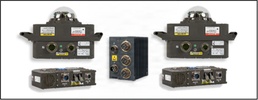
Aberdeen Proving Ground, MD - For more than a decade and a half, the Army’s Advanced Threat Infrared Countermeasure System (ATIRCM) served as a critical line of defense for the CH-47F Chinook. Now, after 16 years of operational service, the system has been fully divested, marking the end of a program that not only met an urgent battlefield need, but redefined survivability for Army Aviation.
The threat of infrared-guided missiles, particularly Man-Portable Air-Defense Systems (MANPADS), has challenged military aviation for decades. Early countermeasures relied heavily on flares and evasive maneuvers to decoy incoming missiles. While effective against earlier threats, advancements in missile seekers demanded more precise, responsive solutions. That solution was ATIRCM, a laser countermeasure that confuses incoming missiles by jamming the seeker head with laser-based energy.
In 2008, as missile encounters targeting Army aircraft surged in combat environments, ATIRCM was designated a Quick Reaction Capability (QRC), a clear signal of operational need.
“Everything originated during the Iraq and Afghanistan conflicts, where the growing threat of surface to air missiles to U.S. Army Chinooks drove the need for enhanced protection,” said David Sears, PM ASE Systems Engineer.
The urgency from leadership was unmistakable. Brig. Gen. Thomas Cole (then Program Executive Officer for Intelligence, Electronic Warfare & Sensors) mandated that we get it in the field in 16 months, and we did it in 14,” said Sears. By November 2009, ATIRCM reached First Unit Equipped (FUE), delivering a critical survivability capability to combat forces at unprecedented speed.
ATIRCM didn’t just fill a gap, it exceeded expectations. Originally envisioned as a temporary solution, ATIRCM’s performance extended its lifecycle far beyond initial expectations.
“We never expected it to have anywhere near the reliability that it turned out to have. They were able to stay in service far longer than anybody expected because of the high reliability,” said Sears.
Through deliberate reliability improvements and sustainment efforts, ATIRCM became mission-essential equipment for deployed Chinook crews. The system protected aircrews and aircraft while saving lives across multiple theaters of operation. While highly capable, ATIRCM came with tradeoffs, most notably its weight which limited its deployment to the Chinook only. Its successor, the Common Infrared Countermeasure (CIRCM), delivers similar capability at significant weight savings, enabling CIRCM to be deployed on the remaining Army rotary fleet.
As threats continue to evolve, so have the Army’s countermeasure systems. CIRCM represents the next generation of infrared countermeasure survivability, building on the lessons learned from ATIRCM while delivering a more agile, scalable solution. CIRCM is designed to receive a target handoff from the missile warning system, acquire and track an incoming missile threat and jam the seeker head with laser-based energy to confuse the missile, thereby always keeping aircrews and soldiers safe. CIRCM’s Open System Architecture allows it to outpace emerging threats.
For those who worked on the program, the transition is both a milestone and a reminder of what ATIRCM achieved.
“It’s very rewarding to wake up and to know that we are protecting our warfighters with our systems,” said Eddie Chong, ATIRCM assistant product manager.
ATIRCM’s story is one of urgency, innovation and sustained excellence. What began as a rapid response to an immediate threat evolved into a mission-essential capability that protected countless Soldiers and aircrews over more than a decade of combat operations. As the Army continues to modernize, ATIRCM stands as a powerful example of what can be achieved when operational need, engineering excellence, and rapid acquisition align.