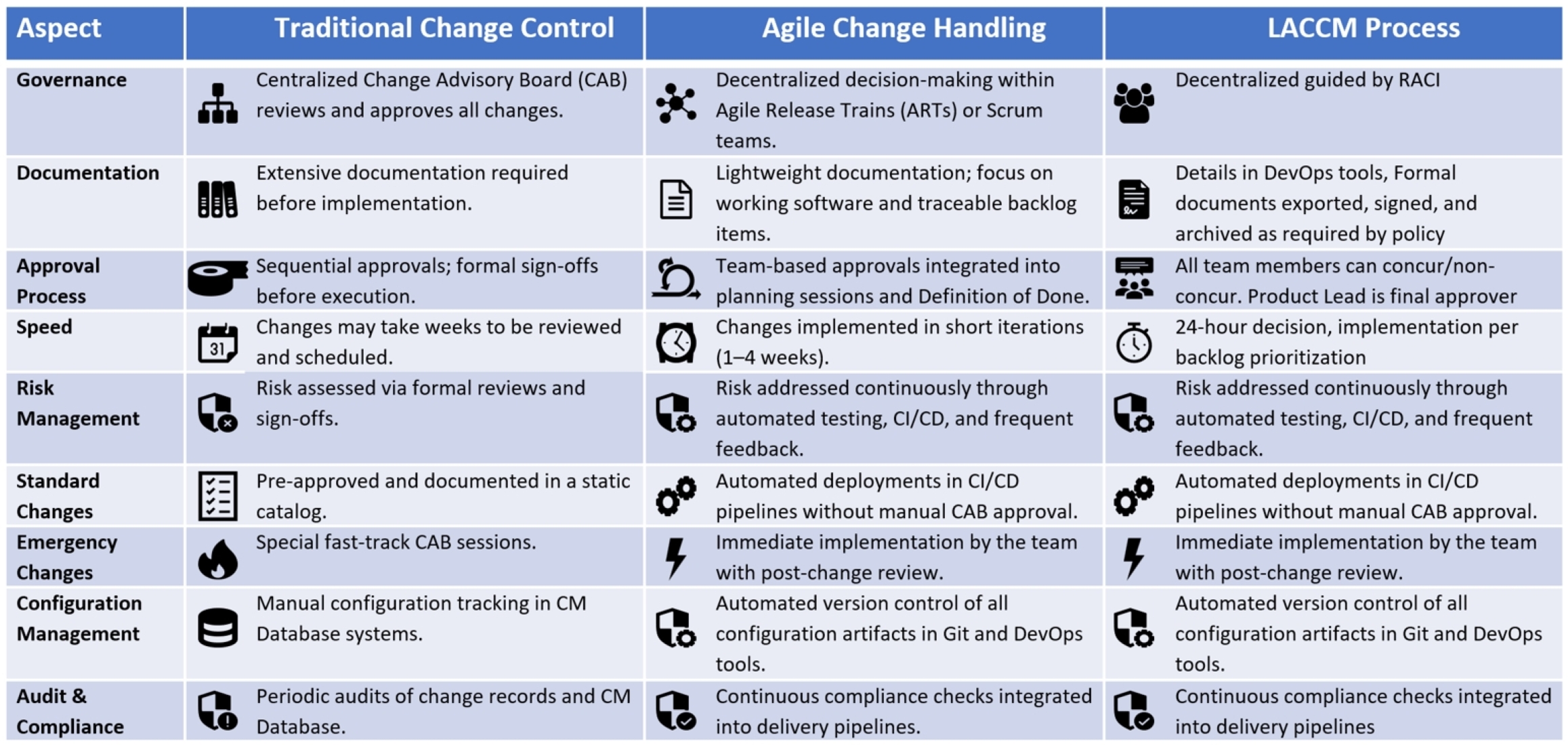
 Aspects of Traditional & Agile Configuration Management Compared to the LACCM Process
by Kelly A. Rutherford
Foreign Military Sales-Army Case Execution System (FMS-ACES) Product Office at U.S. Army Capability Program Executive Enterprise Software and Services (CPE ES2) has fundamentally transformed how the Army manages software changes and configurations in a complex, high-stakes environment. By pioneering the Lean Agile Configuration and Change Management (LACCM) process, the team cut the change adjudication cycle from weeks to less than 24 hourswhile preserving auditability, configuration control and compliance with Department of War and Army policy.
This innovation is not merely procedural—it represents a cultural shift in how Agile methods, DevSecOps practices and Information Technology Infrastructure Library (ITIL) based compliance requirements can coexist in a military acquisition environment.The LACCM process embeds configuration and change decisions directly within Agile sprint activities, empowering technical experts’ immediate authority to resolve issues, prioritize fixes and plan enhancements without the need for burdensome review boards, while maintaining Product Office oversight. The process has already improved communication with stakeholders, increased the speed of capability delivery and reduced administrative work through automation, while improving compliance with the Risk Management Framework (RMF) and ITIL requirements.
The result is a noteworthy achievement:the first Army program to deliver a scalable, auditable, LACCM model for software acquisition—one that not only accelerates modernization of Army systems, but sets a precedent for adoption by all software programs. The FMS-ACES program has fully incorporated the most current Agile best practices used by industry leaders, while demonstrating how software development programs can more efficiently meet congressional and military requirements.
As referenced within Executive Order 14268 (“Reforming Foreign Defense Sales to Improve Speed and Accountability”), FMS is a cornerstone of U.S. national security and foreign policy, supporting allied nations with defense capabilities, while ensuring interoperability with the U.S. military. The Army’s legacy Centralized Integrated System – International Logistics (CISIL), built on Common Business-Oriented Language (COBOL) in the 1980s, has long been the backbone of case management for Army FMS. But after five decades of use, CISIL is outdated, difficult to maintain and incapable of supporting cloud migration, cybersecurity requirements, modern data transparency needs or the potential for advances in artificial intelligence. The Defense Security Cooperation Agency’s (DSCA) Case Execution Modernization Initiativeaims to modernize security assistance across the military services through a federated approach. DSCA and the Army will realize this intent through the decommissioning of CISIL and consolidation of Army reports and the case management application into one modern solution: FMS-ACES.This modernization supports:
The desired end state is a modern, transparent and standardized solutionthat improves execution of every Army FMS case. Against this critical mission backdrop, the FMS-ACES team needed to reinvent traditional Configuration and Change Management (CCM) to meet the need for continuous software modernization in support of military commanders.
When FMS-ACES entered the execution phase of the Software Acquisition Pathway (DoDI 5000.87) in September 2024, no clear guidance existedfor Agile configuration and change management within the Army. The program faced competing demands:
The challenges were compounded by:
In short, FMS-ACES had to create the modelfor a LACCM process that blended rigor, agility, speed and auditability—a challenge no other program had fully solved.
In February 2025, the FMS-ACES Product Office convened a two-day workshop to design and codify a new paradigm: the LACCM process.This pioneering framework embodies four critical goals:
The LACCM process is a balanced integration of traditional CCM strengths (control, accountability) and Agile/DevSecOps advantages (speed, automation, collaboration) with additional efficiencies.
Aspects of Traditional & Agile Configuration Management Compared to the LACCM Process
Key Differentiators:
Examples of LACCM impact include:
Since LACCM’s adoption in spring 2025, FMS-ACES has realized measurable, mission-relevant benefits:
Perhaps the most important achievement is not procedural but cultural: LACCM proves that governance and efficiency are not mutually exclusive. Whereas traditional CCM approaches in acquisition emphasized control at the expense of speed, FMS-ACES demonstrated that:
Prior to LACCM, a simple interface update or defect fix could languish in a review pipeline for weeks. Subject matter experts had to justify changes in lengthy documentation packages, wait for configuration control boards to convene (often monthly) and risk miscommunication since decisionmakers were often not in direct communication with technical experts. This mismatch wasted time, created risk of errors and frustrated stakeholder customers.
LACCM turned this paradigm upside down.By embedding configuration review into daily Agile activities, experts are empowered to take ownership of changes. The process is not imposed externally; it is owned by the Sprint team itself. This sense of ownership increases accountability, speeds delivery, and ensures quality, because the people closest to the work make and validate the decisions.
Additionally, the use of DevOps automation tools means documentation is created and preserved organically as part of normal workflows. This innovation eliminated the duplicative step of creating “audit packages” after the fact. Instead, compliance is achieved continuously, on demand, and demonstrably within systems to which auditors obtain direct access. This “shift left” of governance tasksis revolutionary in the Departmental context, where oversight demands are high, but agility is often constrained. By shifting governance activities into standard workflows, FMS-ACES not only gains speed but reduces the risk of findings during audits and inspections.
The broader significance of the LACCM process lies in its adaptability. Because it is not program-specific, it can:
The FMS-ACES Product Lead has already shared lessons learned with other Army programs exploring Agile CCM approaches. Early indicators suggest FMS-ACES is paving the way for enterprise adoption.
FMS-ACES has achieved something remarkable. Faced with no precedent, incomplete guidance and high-stakes mission demands, the program created the LACCM process—an innovation that transformed adjudication timelines, automated audit compliance, reduced administrative burden and accelerated mission delivery. The LACCM process is a cultural and technological breakthrough—proof that agility and accountability can coexist in Army software acquisition. It has already delivered measurable results for the program, and its potential for government-wide scalability makes it a model for the future. The FMS-ACES LACCM process represents the rare combination of technical ingenuity, leadership and mission impact that not only advances a single program but reshapes how the government approaches software modernization.
KELLY RUTHERFORD is the product lead for FMS-ACES within the Acquisition, Training and Readiness (AT&R) portfolio at U.S. Army CPE ES2. She is responsible for delivering a fully functional and modernized, cloud-native, auditable system for the Army in support of the DSCA 2025 Strategic Goal #3 to improve the effectiveness and efficiency of the Security Cooperation Enterprise. She is also responsible for overseeing the modernization of the legacy CISIL and the consolidation of functionality in ancillary applications to improve CISIL processes and user interfaces.