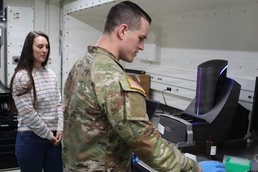
Aberdeen Proving Ground, MD – Trainers at the U.S. Army Combat Capabilities Development Command Chemical Biological Center (DEVCOM CBC) recently completed a deep-dive instructional session with Soldiers from several Army National Guard Civil Support Teams (CST) to familiarize them with new equipment used to detect toxins.
DEVCOM CBC’s training on the new equipment is run in collaboration with the Capability Program Executive for Chemical, Biological, Radiological and Nuclear Defense (CPE CBRND). Through a partnership within the CPE CBRND’s Joint Project Manager for CBRN Integrated Early Warning, the Center has used its technical and operational expertise to lead a series of hands-on, tailored modules promoting equipment proficiency.
During a three-day event held in March at DEVCOM CBC, several members of the National Guard CSTs from units in Georgia, Kentucky and North Dakota were engaged in hands-on training with biologists and trainers from the Center’s Chemical Biological Application and Risk Reduction (CBARR) team. The primary goal was to ensure the CSTs were able to operate the latest version of a system that uses electrochemiluminescence (ECL) immunoassays in the detection of toxins.
The system platform contains a multi-plex assay, which allows operators to scan for and detect multiple toxins including ricin, botulinum toxin, and staphylococcal enterotoxin B. The new system replaces an earlier model and can provide results in under three minutes, providing operators in the field with a rapid capability for use in mobile laboratories.
Crystal Harris, a biologist at DEVCOM CBC, led a group of Soldiers through the training. “Our mission was to ensure all operators are comfortable transitioning to the new equipment,” she said. “By offering training to CST units in a small group setting, we can provide an improved learning experience through individualized attention and adapt the training based on the group.”
Over the course of the training event, Soldiers reviewed operating procedures of the updated ECL immunoassay system and its software, including steps for processing assay plates to check for potential toxins and interpretation of the extracted data. The Soldiers learned from Harris and her fellow biologist, Kendall Babcock, through scenario-driven and guided practice on proper operation in different settings, including mobile laboratories.
Harris and Babcock were selected as instructors because of their experience in environmental sample analysis and their expertise with cutting-edge detection technologies. They have also trained Soldiers and civilians from organizations such as the 20th CBRNE Command’s CBRNE Analytical Remediation Activity (CARA). They facilitated training modules with CARA workforce members, leading sessions on the operation of the Common Analytical Laboratory System Theater Validation Integrated System, a mobile laboratory used in analyzing samples.
The Center develops some of the most sophisticated technologies available that support the warfighter and CBRNE defense enterprise. Advancements such as the newest ECL-based toxin detection system hold no operational value if they do not reach and sustain our warfighters and first responders quickly. Integrated logistics—with a critical emphasis on fielding and new equipment training—are essential to bridge the gap between development and deployment. Through specialized instruction and scenario-based training events like these, the Center’s experts ensure every system is successfully delivered, fully understood, and thoroughly supported in the field.