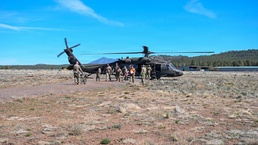
CAMP NAVAJO, Ariz. — Airmen from the 944th Fighter Wing traveled north from Luke Air Force Base to Camp Navajo May 1-3 for Desert Hammer 26-2, the latest evolution of the wing’s ongoing readiness training designed to build battlefield skills, test mission-essential tasks and prepare Citizen Airmen for operations beyond home station.
The field training exercise brought together approximately 150 personnel and included support from Arizona Army National Guard HH-60 helicopters, Marine Corps MV-22 Ospreys and a KC-130. The exercise focused on Mission Ready Airmen skills, aeromedical mission-essential tasks and civil engineer Ready Airmen Training objectives.
Senior Master Sgt. Stephen Hunter, assigned to the 944th Fighter Wing Exercise Planning Office, said Desert Hammer 26-2 was not a stand-alone event, but part of a deliberate training progression that continues to evolve with the wing’s readiness needs.
“We are being tasked to exercise our mission while developing battlefield skills and being ready now,” Hunter said. “While we have members downrange right now, we’re continuing to train our Airmen that we’re not tasked to deploy, and it’s a building block approach.”
Hunter said the wing previously conducted training at Luke AFB and Gila Bend to reinforce basic battlefield skills. Camp Navajo gave Airmen the opportunity to take the next step by operating in a field environment with terrain, landing zones, drop zones and training venues not available at Luke.
The exercise included airlift of Airmen from Luke AFB to Flagstaff, cargo airdrop operations, medical scenarios, live practice patients, high-fidelity mannequins, critical care air transport team training, land navigation and survival training.
For Hunter, the clearest validation of the wing’s training progression has come from Airmen already deployed. “In fact, the Airmen downrange right now have sent messages back that they appreciate all the training over the last cycle, that they are executing what they trained at Luke Air Force Base at Gila Bend,” Hunter said. “So if there’s a measuring stick, that’s it for me. And we just have to always be as ready as we can be.”
Hunter said those repetitions matter because readiness must be built before Airmen are called to execute in real-world conditions.
“It’s trial by fire in combat, and so as many reps as we can get now is just what we’re supposed to be doing, and that’s why we’re here,” Hunter said.
Lt. Col. Lance M. Waage, 944th Mission Support Group deputy commander, joined the unit in January but brings years of Reserve experience. He said Desert Hammer 26-2 gave Airmen a chance to train across multiple mission areas while adapting to unfamiliar terrain.
“To be able to execute our jobs in multiple or varied types of environments is really important,” Waage said. “Being up here today allows us to stretch our legs and get those reps and sets in that are very necessary.”
Waage said the 944th Fighter Wing is known for training fighter pilots, but the wing also maintains a deployable force capable of supporting a broad range of Air Force missions worldwide. Training events like Desert Hammer 26-2 help Airmen from different functional areas understand how their roles connect in a deployed environment.
“This is a great way for every different skill set and functional area to perform under more austere conditions, sometimes simulated combat conditions, and really bring us together in a way where we’re seeing how a scenario would play out before we have to do it for the real thing,” Waage said.
For reservists, that training is compressed into limited time. Waage said Reserve Airmen balance civilian careers, family responsibilities and military requirements while still preparing to answer national security demands.
“We have only 16 hours each month to perform everything that an active-duty force does and that is a huge challenge,” Waage said. “It’s a huge testament to all the great people that come together for reserve duty.”
Hunter said seeing the wing execute the exercise was rewarding because planners could bring together the pieces, then watch Airmen carry out the mission.
“We brought all the puzzle pieces here today, and then we sort of sit back and watch the fighter wing put the puzzle together,” Hunter said. “If the Airmen are happy and they’re learning and they’re more ready now, then we’re doing our job.”
As Desert Hammer 26-2 concludes, Hunter said the wing will capture feedback and lessons learned to improve future training.
“Whatever small changes we can make to make it better next time, we’re listening,” Hunter said.