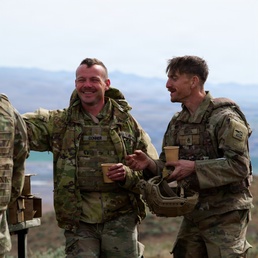
The 2-146 Field Artillery Battalion showed up for their annual training event on April 8, 2026, ready to spend two weeks in the field as an integral part of Operation Courage Lethality at the Yakima Training Center. Their mission: demonstrate their readiness to support and defend their state and nation.
While National Guard members are typically on duty one weekend per month, every year they engage in AT – two weeks of training, putting their skills to the test.
“AT is the accumulation of everything that you've learned during [Inactive Duty Training] IDT’s brought into a simulated battlefield,” Staff Sgt. Jacob Bradley, supply sergeant for Bravo Battery, 2-146 said. “We perfect individual tasks throughout the year, then bring sections together — especially at brigade level — to operate as an army on a grander scale… Civilians should know we take training seriously — full-time or part-time — to be as lethal and efficient as active duty when called. We don’t take it lightly.”
During this exercise, the brigade worked as a whole to execute a live fire control exercise as a technical rehearsal for their ability to plan, synchronize, and execute multi-domain lethal and non-lethal fires and effects in support of I CORPS – an active duty U.S. Army unit headquartered at Joint Base Lewis-McChord, Washington, specializing in Indo-Pacific operations.
For the majority of National Guard service members, AT is a major divergence from their everyday life. Guard life, due to being a unique hybrid experience where you live as a full-time civilian and a part-time soldier, is often described as living in two worlds simultaneously. Throughout the year, guardsmen work in a wide range of professions — in schools, hospitals, law enforcement, or, in the case of Spc. Jose Martinez, a Fire Control Specialist for the 2-146, as a grocery store clerk.
“It's weird because I'm doing normal city stuff and then they're like, 'Hey, we're gonna be out [in the field] for two weeks,'” Martinez said. “So, once I hear that, my mind kind of switches. I guess I have a little switch that flips to help me integrate myself back into civilian and/or military [environments].”
That ability to transition quickly is a skill guardsmen have to learn. A battalion-level fire control exercise is a multifaceted operation that involves solid communication, fast reflexes, and polished skills.
"Once the sensor identifies a target, they'll send up what is called a call for fire mission,” Bradley said. “We send up the call for fire, and then it gets routed to what is called an FSC, Fire Support Center… based on their judgment, based on ammo count, based on the commander's intent, they will either approve it or deny it. If it is approved, then it goes over to what is known as the Fire Direction Center. They are another control measure that will verify the rounds, verify that the guns can shoot it, and verify that it's within safe parameters. Once they approve it, then it gets [sent] down to the gun line… They will then get the gun ready and their whole crew will start working together to get the right quadrant and deflection on the gun and the traverse on the gun…. Then, they fire it."
On the battlefield, this process must be executed quickly and efficiently, and that is what they 2-146 showed they are ready for.
Whether it’s leaving normal civilian routines, engaging in complex training, or adapting to unique field environments, AT can present challenges for guardsmen. For the 2-146, their response to this challenge is one that many guardsmen share.
“I love doing this,” Spc. Lena Schmidt, Cannon Crewmember for Alpha Battery, 2-146 said.
As a Cannon Crewmember, she is an integral part of the crew responsible for firing the guns, which, while exciting, isn’t glamorous.
“I feel really gross again,” Schmidt said, covered in soot. “I ran out of baby wipes because the first three days we were here, I was doing two full body wipe downs… That's one thing you can never pack too many of – baby wipes.”
Despite the challenges, Schmidt and her team related their experiences with smiles, sharing supplies to help their team in whatever way they could.
“When we have downtime, we'll all just sit down and talk and hang out,” said Spc. Kimbrel Boyer, fire control specialist for the 2-146, “talk about how AT's going, check up on each other, and it's just really nice. Our lieutenant calls us a family, which is what it feels like.”
Members of the 2-146 returned home from training not just tired but sharpened and ready to step back into their civilian lives, carrying the confidence that, when called, they can operate as one cohesive, capable team.