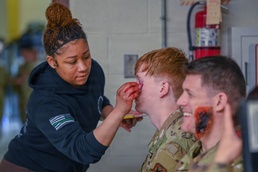
SPRINGFIELD, Ohio — Members of the U.S. Air Force School of Aerospace Medicine applied lifelike moulage to airmen at the 178th Wing April 10-12, simulating injuries ranging from amputations and eviscerations to bruising and penetrating trauma.
The simulations were part of a three-day natural disaster response exercise centered on a simulated tornado strike on the base. The high-tempo event required airmen from multiple units across the 178th Wing to navigate infrastructure damage and triage mass casualties, testing their ability to perform Tactical Combat Casualty Care under pressure.
Brandon Baker, a civilian member of the Air Force School of Aerospace Medicine, said his team provided extensive moulage support to ensure the graphic nature of the simulated injuries shifted the participants' mental state before they ever began treatment.
"You want to do this because it brings realism to the exercise," Baker said. "It puts the participants really sort of in a state of mind, like, this happens, this is what injuries look like."
Aerospace medical technicians supervised the responders, providing on-the-spot feedback as airmen treated the simulated casualties. For the instructors, that realism serves as a critical function.”
"You don't want their first experience seeing an extreme injury to be in the field," said Tech. Sgt. Kathrynn Theopolos, a 178th Wing aerospace medical technician. "The airmen showed a high level of commitment and professionalism. They approached every simulated casualty with the same urgency and focus you would expect to see in an actual mass casualty event."
Standard medical training often relies on clean environments and static mannequins, but the moulage forced responders to confront the visual and psychological stressors of severe trauma.
"More realistic moulage allows for service members to get a more brutal, stressful and genuine look at what kind of injuries they will see in real-life situations," said Airman Dylan Glunt, a 178th Wing aerospace medical technician.