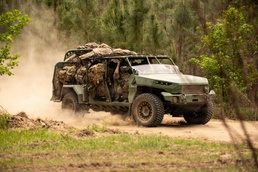
FORT STEWART, Ga. — For Soldiers who train on the sprawling ranges and dense wetlands of Fort Stewart, the path to combat readiness is anything but easy. Thick forests, swampy grounds and relentless southern heat create an unforgiving training environment, yet those very challenges are what make the installation one of the Army’s most valuable proving grounds for building globally ready armored formations.
Across miles of rugged terrain, Soldiers navigate mud-filled trails, dense vegetation and waterlogged fields that test both equipment and endurance. The conditions are demanding, but leaders say the difficulty is exactly what prepares units for the realities of modern warfare.
“You look at many other armored brigade combat teams and they’re training on flat, open desert,” said 1st Lt. Quinn Hutchins, assigned to 2nd Battalion, 7th Infantry Regiment, 1st Armored Brigade Combat Team. “But not us—here in the 3rd Infantry Division we train in the middle of the swamp. I think that’s a great place for us to be, because when you look at the terrain we may operate in, particularly in parts of Eastern Europe, it prepares us for what the fight could actually entail.”
Hutchins explained that the environment forces Soldiers and crews to solve real-world problems during training. Vehicles can become stuck in thick mud, requiring recovery operations. Maintenance demands increase as humidity, heat and wet terrain place additional stress on equipment. At the same time, dismounted Soldiers must learn to maneuver through vegetation and marshland that slows movement and restricts visibility.
“All of those challenges force us to adapt,” Hutchins said. “When you train hard in conditions like this, it makes the actual fighting easier when the time comes.”
The terrain at Fort Stewart is not only physically demanding—it also offers a unique mix of environments that mirror operational conditions around the world. From dense tree lines that restrict line of sight to open maneuver corridors and marshy lowlands, the installation provides a range of tactical scenarios for armored units to navigate.
“Fort Stewart’s terrain builds globally ready armored formations.” said Capt. Robert Seals, a company commander in 5th Squadron, 7th Cavalry Regiment. “Here in the subtropics we have a really good blend of terrain that simulates both congested lines of sight and limited open areas, similar to what you might see in Eastern Europe. At the same time, we also have very wet, marshy ground where traditional armored vehicles don’t perform particularly well—conditions you might find in places like Southeast Asia.”
Training in that environment forces units to think differently about maneuver, logistics and coordination. Leaders must account for terrain that slows vehicles, limits communications and challenges even the most experienced crews.
“The training ground here is absolutely brutal,” said Seals. “It can be unfriendly to vehicles, and it’s very difficult for dismounted Soldiers to move through because the terrain is soggy and wet. When you combine that with the humidity and long training days, it pushes our formations mentally and physically. But the more we train on this ground, the more capable we become.”
Those challenges are by design. Leaders emphasize that realistic training environments are critical to preparing Soldiers for the unpredictable conditions of large-scale combat operations.
“It looks flat, but it’s not,” said Lt. Col. Jon Roland, the battalion commander of 5th Squadron, 7th Cavalry Regiment. “There’s variability. There’s micro-terrain, swamp and a host of natural and man-made obstacles that units have to navigate.”
That complexity forces units to slow down, analyze the terrain and develop deliberate plans for movement and maneuver. Whether Soldiers are conducting reconnaissance missions, maneuvering armored vehicles through narrow corridors or coordinating dismounted patrols through marshland, the environment ensures every training event becomes a learning opportunity.
For the Soldiers of Fort Stewart, the difficulty of the terrain is not a disadvantage, it is a competitive edge. Every muddy recovery operation, every humid field exercise and every obstacle encountered in the woods contributes to a force that is more adaptable, more resilient and better prepared for global operations.
In the end, the hard ground of Fort Stewart serves a clear purpose: Building tough, disciplined Soldiers capable of operating anywhere in the world.
Difficult terrain creates hard training. And hard training produces the tough Dogface Soldiers ready to answer the nation’s call.