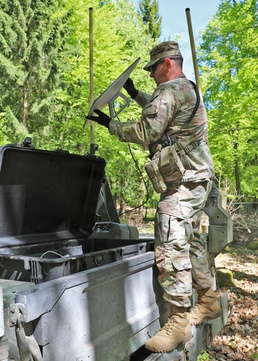
HOEHNFELS – U.S. Army Observer/Coach-Trainers with 7th ATC, Joint Multinational Readiness Center’s Grizzly Team are testing innovative technology providing mobile network signal across the battlespace with the Banshee Mobile Radio (BMR) / Battlefield Edge Network during Combined Resolve 26-07.
The portable network radio system is compact, simple to set up, and provides a critical network signal to units across the battlefield. Soldiers can load a small, tough box containing a Starlink antenna, router, cables, and a switch onto a vehicle, drive to a remote location, and set up rapidly, linking unit communications and systems.
“We can set this up in just a few minutes,” said U.S. Army Sgt. 1st Class Robert Malone, a Signal O/C-T with Grizzly Team. “We can access the Banshee network from any commercial off-the-shelf device as long as it has the Banshee SIM card that connects to an LTE Cell network.”
During these rotations, information is traditionally shared with the JMRC analysts via radio or other data platforms. The Banshee bridges the gap between disconnected systems, allowing the command to host them on a single platform rather than across different networks.
“We are the only Combat Readiness Center doing computerized rotational data collection and reporting on the Banshee network,” said Sgt. 1st Class Teresa Bocanegra, a Grizzly Team O/C-T.
She explained how casualty reports that were once sent up via traditional radio can now be entered directly and transmitted to the command post. In fact, all the reports that line units are doing, like fire missions, can be submitted via this system, and the Army is working on a solution with Palantir to enable real-time soldier tracking. Transmitting the volumes of data is possible thanks to the Banshee’s network.
According to Malone, the Banshee has its own internal network separate from commercial networks or traditional army NIPR or SIPR networks. The systems work to relay data and Intelligence, Surveillance, Reconnaissance (ISR) control from device to device in austere conditions, providing an enhanced level of maneuverability for signal.
“Soldiers can even access the Army Virtual Desktop and other commercial applications we use from the battlefield,” he said.
While adversaries may target military networks by disrupting or denying access to GPS signals, the Banshee network employs technology that enables it to continue operating even if GPS access is denied. GPS signals can also be affected by terrain and other factors, so testing the effectiveness of these devices in simulated battlefield conditions is key to providing feedback to developers so they can make adjustments or improvements.
“Using these devices here allows us to assess their capabilities in real-world conditions,” said Malone. “The tree canopy, terrain, and weather are all things that impact communications, so testing in this environment lets us know what the limitations of the system are.”
So far, Malone has been impressed by the system's durability.
“I was a bit skeptical at first,” he said. “The radio has held up pretty well out here. It’s been pretty durable.”
As other units rotate into “the box” for Combined Resolve, Grizzly Team O/C-Ts continue to evaluate the Banshee system’s ability to provide secure mobile connectivity in this environment, enabling units to better understand how these emerging technologies can support mission command across the battlefield.