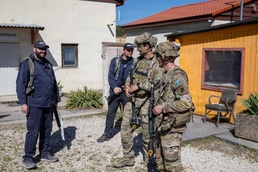
HOHENFELS, Germany – At the 7th Army Training Command's Joint Multinational Readiness Center, Soldiers from the U.S. Army Reserve’s 418th Civil Affairs Battalion are demonstrating that innovation on the modern battlefield doesn’t always come from top‑down programs. Sometimes, it starts with a laptop, a problem set, and a Civil Affairs Soldier determined to close a gap.
During Combined Resolve 26‑07, the U.S. Army Europe and Africa‑led exercise involving more than 3,800 participants from seven nations, the 418th Civil Affairs Battalion is working alongside Kosovo Security Force partners to test an agentic AI tool designed to drive decision advantage in civil environments.
Developed by a small tech firm composed of Army Civil Affairs reservists, the system gives teams operating in the civil environment the ability to rapidly integrate, analyze, and act on insights gleaned from civil data that is a critical capability on today’s data‑centric battlefield.
Combined Resolve, held from April 9 to May 10, 2026, is the Army’s premier overseas combat training center rotation. The exercise validates warfighting readiness and accelerates transformation by integrating new technologies, becoming a proving ground for how deployed units can outpace adversaries by experimenting with drones, electronic warfare, counter‑UAS systems, and data‑driven tools in real time. It is also the only training environment where lessons from ongoing conflicts in the same theater feed directly into U.S. Army scenarios.
For Civil Affairs teams, those lessons increasingly revolve around civil data. Units must know how to gather it, verify it, and turn it into something commanders can act on.
The concept for the platform, known as the “Civil Environment Navigator,” originated from data‑analytics requirements identified by Civil Affairs teams supporting the Eastern Flank Deterrence Initiative. What began as Excel sheets and Power BI dashboards eventually transformed into a fully agentic solution composed of more than 20 AI agents working together across eight core components.
Capt. David Mitchell, a civil affairs officer in the 418th Civil Affairs Bn. and one of the members of the program team said, “The platform is a suite of interconnected capabilities designed to support teams operating in civil environments, including civil affairs, psychological and information operations, for both special operations forces and conventional.” Mitchell continued, “This is a single tool that enables Soldiers to conduct civil‑operations planning through post‑operation reporting.”
Several of the core capabilities include mission analysis, monitoring information narratives, building network maps, rehearsing critical conversations, modeling likely scenarios, and producing reports and other products. This mirrors the Army’s broader transformation goals. Civil Affairs Soldiers are applying the same mindset seen in drone and electronic warfare experimentation by identifying gaps and building solutions that increase speed, accuracy, and interoperability.
Capt. Addison Clayton, mission commander of the 418th Civil Affairs Bn., said, “On past missions, I’ve spent hours analyzing information and writing reports on our engagements. Using an AI‑integrated software allowed my teams to spend less time reporting and more time focusing on planning and preparing for the mission.”
Kosovo partners have been central to refining the system within the exercise. Working together during missions, the teams tested how the tool handles notes, differing report formats, and the unique civil‑military dynamics of soldiers from the Balkans. Their collaboration reflects the exercise’s emphasis on NATO convergence and interoperability. With the Army’s increased focus on the Eastern Flank Deterrence Initiative, the partnership at JMRC shows how allied and partner forces can learn from one another.
The system is not intended to replace current Army systems, but to complement them by bridging the gap between analog note‑taking and digital analysis. Its mapping capability allows Civil Affairs teams to visualize trends, identify emerging issues, and brief commanders with greater clarity.
As Combined Resolve concludes, the 418th Civil Affairs Bn. will refine the system based on feedback from U.S., NATO and partner users, demonstrating how tactical‑level innovation can enhance readiness and understanding of the human terrain that shapes every mission.