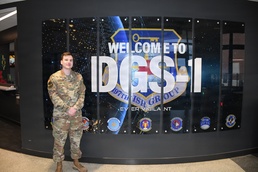
YOKOTA AIR BASE, Japan – A U.S. Air Force reservist assigned to the 718th Intelligence Squadron supported multinational intelligence operations in Japan as part of the U.S.-Japan Bilateral Intelligence Analysis Cell (BIAC), reinforcing information sharing between the Japan Self-Defense Forces (JSDF) and U.S. Forces.
Established Nov. 29, 2022, at Yokota Air Base, Japan, the BIAC reflects the continued evolution of U.S.- Japan defense initiatives and strengthens combined intelligence operations with key regional partners, now including Australia.
The primary function of BIAC is to jointly analyze and process information that supports mutual security and cooperation. U.S. and Japanese analysts work side by side to analyze video feeds from remotely piloted aircraft, producing intelligence that informs decision-making by defense leaders in both nations. The BIAC also provides analysts with opportunities for information exchange, analytical training, operational experience, and collaboration in a combined-joint environment. By working with sister services and allied nations, analysts gain exposure to different exploitation methods, analytical frameworks, and diverse methodologies, bringing back a unique perspective and enhanced capabilities to their units.
Tech. Sgt. Joshua Osborne, a traditional reservist assigned to the 718 IS was mobilized to Yokota Air Base, Japan in support of the BIAC. Osborne is a career reservist who has served with his unit for nine years and has previously been mobilized multiple times throughout his career.
During his deployment, Osborne served as Imagery Mission Supervisor (IMS), leading one of four multinational teams within the BIAC. In his role, he coordinated intelligence collection efforts between U.S., Japanese, and Australian personnel and oversaw a team of eight joint service members. His team’s work directly supported intelligence sharing with the Japanese Defense Intelligence Headquarters and contributed to combined operations across the Pacific theater.
“Tech. Sgt. Osborne led our BIAC team with a clear vision of direction and a positive approach,” said Staff Sgt. Diana Sauer, geospatial intelligence analyst from the 101 IS, Otis Air National Guard Base, Massachusetts. “He had a strong sense of leadership that kept the team focused and organized. With a devoted and ambitious attitude, he led our team toward mission success and highlighted the importance of our work that produced real-time impacts.”
Osborne said the experience in Japan was both professionally and personally transformative. Initially concerned about stepping away from his civilian career and newly established life in North Carolina for six months, he said the assignment ultimately reinforced the importance of the mission and the value of building trust with allied partners.
Osborne emphasized the importance of cultural awareness when operating in a multinational environment. He said that understanding cultural differences and adapting leadership approaches helped strengthen collaboration and trust within the cell.
“When working with allies, we have to change our approach,” Osborne said. “Understanding cultural differences and applying that understanding to how we do the mission is essential.”
In addition to mission responsibilities, Osborne had the opportunity to travel throughout Japan during his deployment, visiting several major cities and immersing himself in the local culture. He said the experience broadened his perspective and deepened his appreciation for the partnership between the United States and Japan.
Upon his return, Tech. Sgt. Osborne received the Air and Space Achievement medal for his exemplary service in support of the BIAC.
The 718th Intelligence Squadron’s continued support to the BIAC provides Airmen with unique analytical training and operational growth opportunities that can’t be replicated in a classroom environment and further emphasizes the 655th Intelligence Surveillance and Reconnaissance Wing’s dedication to supporting international operations and allied partnerships.