LEHI, Utah - The Utah National Guard hosted Exercise Wolverine across various locations in northern Utah, April 30, 2026. Bringing together military, civilian, academic and industry partners working scenarios for a contested homeland environment, Exercise Wolverine emphasizes collaboration between agencies with a focus on homeland security.
Key training events for Wolverine included emergency medical response and casualty evacuation operations, using the Medical Simulation Training Center (MSTC) at Camp Williams, Utah. The MSTC uses advanced, life-like mannequins to simulate traumatic injuries. The facility is designed to challenge medical personnel surrounding patients and providers with explosive sounds, smoke, and different smells to simulate a battle zone. It also provides training for community partners including local fire and police departments, emergency medical services, and SWAT teams.
In preparation for medical and casualty response operations, the medical team set up triage tents in two locations, including the MSTC and a simulated rubble pile in a training area located on the far west side of Camp Williams. The MSTC was used as a mobile hospital, with multiple rooms set up to treat patients and simulate power outages. Volunteers played a crucial role in the exercise, dressing in moulage, displaying realistic injuries including burns, fractures and bleeding lacerations, allowing medical teams to treat real patients.
“This year we had one civilian site participate, next year the plan is to integrate more emergency medical services,” said Utah Air National Guard Maj. Ryan Robison, plans officer assigned to the 151st Medical Group. “So hopefully we can build this with the state so that it becomes a yearly thing across all avenues of medical support,” he said.
Robison explained that the MSTC helps community partners train together and build confidence, strengthening the Utah National Guard’s ability to mobilize quickly and operate cohesively in an emergency.
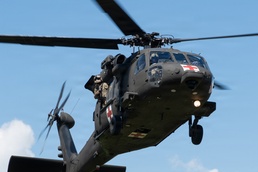
The joint medical response event started with a simulated train derailment. Crashing into a building holding hazardous materials, medical squads maneuvered though the rubble, squeezing though confined spaces in hazmat suits, testing for harmful chemicals and searching for casualties then extracting them from the debris. The on-site medical team provided immediate treatment, while also testing for chemical exposure. Patients who needed more extensive care were transported by UH-60 Black Hawk helicopters and moved to triage tents set up outside the MSTC at Camp Williams. After processing the patients, more severe casualties were moved into the treatment area in the MSTC and with the aid of patient simulators the medical team performed life saving medical treatment in a realistic high stress scenario training.
“Being able to learn from them in real time was really valuable,” said Senior Airman Tiffany Croxall, a medic assigned to 151st Medical Detachment 1. “ Having something that reacts realistically makes it a lot easier to recognize injuries and treat them.”
The medical response event brought Air and Army guardsmen together through new hands-on training and provided a better understanding of the capabilities that are available during any domestic crisis. Living true to the ethos “Always Ready, Always There” the joint training event enhanced interoperability and strengthened the National Guard’s ability to mobilize and effectively defend the homeland.