FORT SHAFTER, Hawaii — In a region where competition increasingly unfolds in the information space rather than on the battlefield, the U.S. Army’s newest formation is taking its mission directly to allies and partners across Oceania.
Leaders from the 1st Theater Information Advantage Detachment conducted a multi-nation engagement from Jan. 26 to Feb. 7 across Australia, New Zealand and Papua New Guinea, introducing the unit’s capabilities and strengthening coordination with key regional partners. The trip marked one of the detachment’s first major international engagements since its activation in November, signaling the arrival of a new U.S. Army capability focused on competition in the information environment.
Commanded by Col. Sean Heidgerken, the Hawaii-based unit is designed to operate in the space between peace and conflict, often referred to as the gray zone, where adversaries use influence, disinformation and coercion to achieve strategic effects without open warfare.
“This is about showing up early, building trust, and operating alongside our partners before a crisis ever develops,” Heidgerken said during the trip. “We’re here to strengthen relationships, align efforts and ensure that together we maintain the initiative in the information environment.”
The engagement began in Canberra, where Heidgerken and a team of information capability leaders met with officials from Australia’s Department of Defence to discuss how the 1st TIAD intends to integrate with Australian forces and other regional partners. Discussions focused on synchronizing information-related capabilities, sharing best practices and identifying opportunities for future cooperation.
The team also met with representatives from Australia’s Department of Foreign Affairs and Trade to understand how they view the information environment across Oceania, reinforcing the importance of a whole-of-government approach to information competition.
At the Australian Defence Force Headquarters Joint Operations Command, the delegation exchanged insights on coordinating information capabilities in support of operational objectives. Leaders discussed training opportunities, interoperability and methods to better synchronize messaging and actions across military and civilian organizations.
“Australia and the United States are both proud members of the Pacific Community. We very much look forward to working with 1st TIAD in maintaining peace and stability in our region,” said Australian Defence Force Navy Cmdr. Fenn Kemp, the international engagements officer assigned to the Headquarters Joint Operations Command, “we have much in common, and that includes a commitment to countering malign ifluence across our region.”
Kemp continued to state, “1st TIAD structure and intent is so well tailored to confronting these information challenges.” Before departing Australia, the team visited the U.S. Embassy in Canberra, meeting with representatives from the offices of the defense attaché and public diplomacy to ensure alignment of regional messaging and strategic objectives. The delegation then traveled to Wellington, New Zealand, where they met with leadership at New Zealand Defence Force Headquarters to introduce the unit’s capabilities and learn more about New Zealand’s approach to the information environment. The visit emphasized shared goals in maintaining regional stability and strengthening resilience against malign influence.
At the New Zealand Joint Operations Command, discussions focused on current operational priorities and best practices for engagement across Pacific Island nations. The team also visited the U.S. Embassy in Wellington, coordinating with public diplomacy and defense attaché personnel to align communication efforts and regional objectives.
The final leg of the trip took the team to Port Moresby, Papua New Guinea, a strategically significant location in the Southwest Pacific. There, Heidgerken and his team met with U.S. Embassy officials to better understand the local environment, including cultural considerations, communication practices and regional dynamics.
The team also engaged with representatives from the Australian High Commission discussing current Australian Defence Force operations in Papua New Guinea and opportunities for integrating into the local information space. Capt. Avery Smith, a public affairs officer assigned to the unit, emphasized how the detachment is rethinking traditional approaches to communication.
“In the U.S. Army, the characteristics of the offense are speed, concentration, audacity and tempo,” Smith said. “In public affairs, we must apply those same principles into the information space to maintain the advantage over our adversaries.”
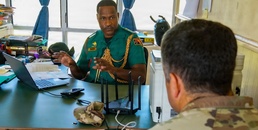
In Port Moresby, members of the detachment met with the public affairs officer of the Papua New Guinea Defence Force at Murray Barracks, discussing how information capabilities can support mutual objectives and strengthen communication efforts within the region.
For the 1st TIAD, integrating public affairs, information operations and other capabilities into a unified effort is central to its mission. The unit is designed to synchronize multiple information-related disciplines to operate effectively in a complex and contested environment.
Maj. Tyler Claus, an information operations officer assigned to the unit, highlighted the historical continuity of allied cooperation in the region.
“The U.S. Army has a long history of fighting side by side with its allies and partners against aggression in the Southwest Pacific, stemming from the Second World War when American, New Zealand, Australian and Papuan soldiers defeated the Imperial Japanese effort to capture Port Moresby in 1942,” Claus said. “While the current fight against disinformation is different than fighting through the Kokoda Trail, it is no less significant.” That perspective underscores how today’s competition, though different in form, remains deeply tied to longstanding alliances and shared commitments across the Pacific. Throughout the trip, the consistent theme was integration: aligning military, diplomatic and informational efforts across nations to ensure a unified approach to regional challenges. In the gray zone, where influence and perception shape outcomes, that alignment can determine whether partners maintain access, resist coercion or remain resilient in the face of external pressure.
“The Indo-Pacific is a team sport,” Heidgerken said. “No single nation operates alone in this space. Our strength comes from how well we integrate, communicate and act together.”
The engagements also reinforced the growing recognition among regional partners of the importance of the information environment. Countries across Oceania are increasingly investing in their own capabilities to counter disinformation, strengthen national narratives and build resilience within their populations. For the 1st TIAD, the trip represented more than introductions, it was a demonstration of presence and intent. As strategic competition intensifies in the Pacific, the detachment is positioning itself as a key enabler of cooperation and coordination in the information space.
The message was clear: the United States and its allies are not only present in the region but actively engaged in shaping the information environment alongside trusted partners.
The 1st Theater Information Advantage Detachment is a U.S. Army formation based in Hawaii and aligned with U.S. Army Pacific. The unit conducts targeted information advantage activities across the Indo-Pacific to counter malign influence, strengthen partnerships and support regional stability in support of U.S. Indo-Pacific Command objectives. As the first of three planned detachments, the 1st TIAD integrates multiple information-related capabilities to operate in the information environment, enabling the joint force and its allies to compete effectively across the competition continuum and maintain a free and open Indo-Pacific.